Composite vs. Wood vs. Metal Deck Railings: Which Survives Buffalo Winters?
Picking a deck railing in Western New York is a two-part decision: it has to meet New York's residential code, and it has to hold up through freeze-thaw cycles that punish weak materials. This guide to deck railing material comparison examines composite, wood, and metal options and addresses both concerns, because a railing that looks great in June but wobbles by March failed at its one real job. If you are planning an elevated or multi-level deck on a sloped Buffalo lot, the railing choice matters even more; you will have more linear feet of it, more stairs, and higher fall heights than a basic flat deck.
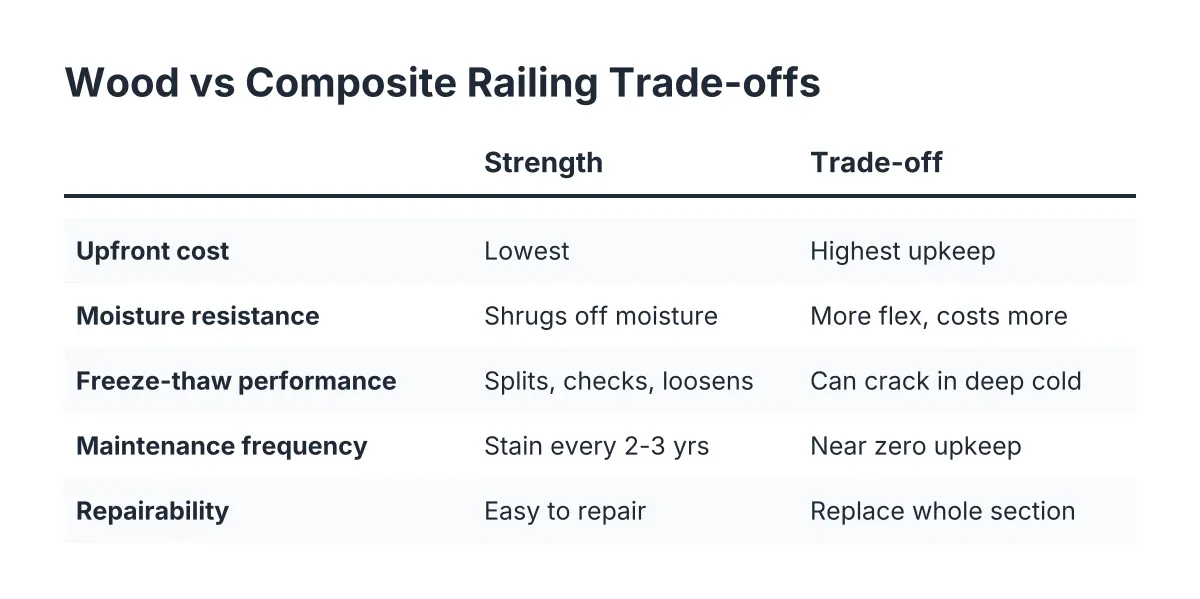
Here is the short version. Wood costs the least upfront and demands the most maintenance. Composite railing shrugs off moisture but flexes more and costs more. Metal deck railings, usually aluminum, handle snow, ice, and temperature swings better than either, with the fewest maintenance hours per year. The right answer depends on your deck height, your budget, and how much fall protection your layout actually needs.
Code First: What Every Railing Must Do in New York
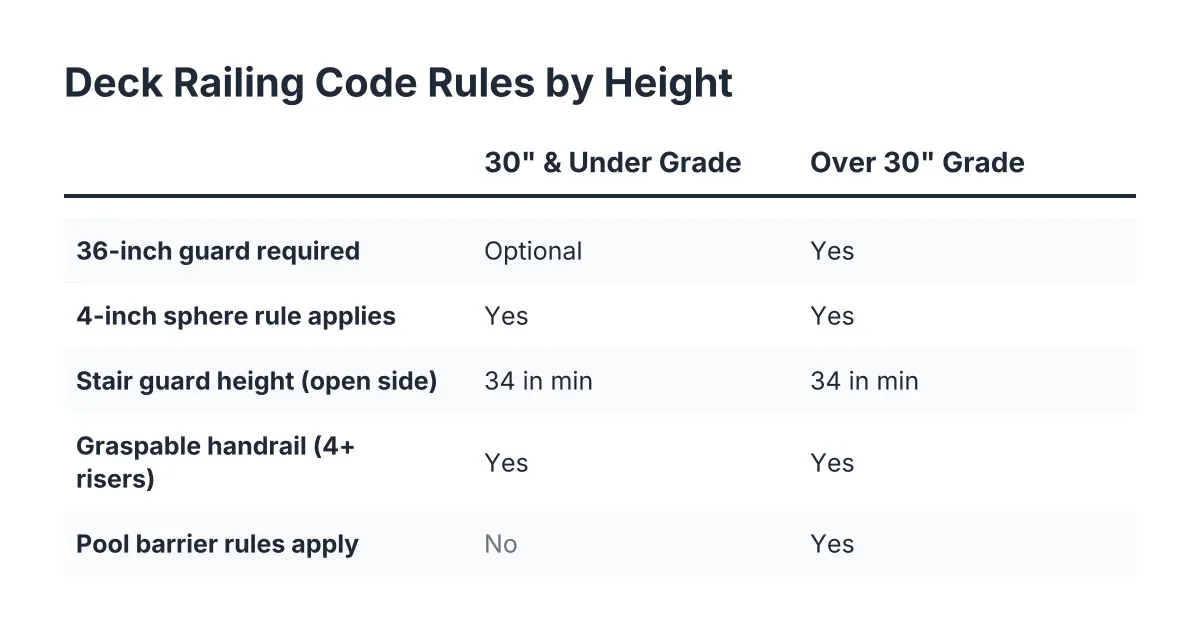
Before comparing materials, get the code baseline down, because it applies to all three. New York's residential building code, based on the IRC as adopted, requires a 36-inch guard height once a deck's walking surface is more than 30 inches above grade, according to Mister Baluster. That 30-inch trigger matters a lot on sloped lots. A deck that sits 20 inches above grade at the house can easily be 50 inches above grade at the far corner where the yard drops away.
Beyond height, deck railing code requirements cover a few more points that hold regardless of material:
- Balusters or infill cannot allow a 4-inch sphere to pass through, which protects kids and pets.
- Guards must resist a concentrated load applied at the top rail, so deck railing posts need solid blocking and hardware, not just lag screws into rim board.
- Stairs with four or more risers need a graspable handrail between 34 and 38 inches above the stair nosings.
- Openings at stair guards follow their own sphere rule, so deck railing for stairs is measured differently than level runs.
Therefore, when you compare materials, you are comparing how each one meets these rules over time in a climate that heaves footings, soaks end grain, and loads top rails with drifted snow. A railing that met code the day it was installed but loosened after three winters no longer meets code in any way that matters.
Wood Railing: Lowest Cost, Highest Upkeep in Freeze-Thaw Country
Pressure-treated wood is still the most common railing in WNY because it costs the least per linear foot and any deck builder can work with it. On a big multi-level deck with long guard runs and two or three stair flights, that upfront savings adds up fast.
The trade-off is what Buffalo weather does to it. Wood absorbs water. When that water freezes, it expands inside the grain. Over repeated freeze-thaw cycles, that means checking, splitting, and loosening at every fastener. The classic complaint that sends homeowners searching for a deck railing loose fix is usually a wood post that has shrunk, split, or rotted at the base where snow sat against it all winter.
Wood railing in this climate needs staining or sealing every two to three years, closer to two on south-facing runs that take full sun after wet winters. Skip a cycle and the top rail, the flat surface where snow sits longest, grays and checks first. On the plus side, wood is easy to repair in sections, easy to customize for odd angles on a multi-level layout, and forgiving when a design changes mid-build.
Wood makes the most sense when the budget is tight, the deck is low, and the owner is honest with themselves about maintenance. It makes the least sense on a tall elevated deck where re-staining means working off a ladder over a slope.
Composite Railing: Built for Moisture, Watch the Span and Flex
Composite railing pairs naturally with composite decking, which is why so many new-construction homeowners comparing composite vs. wood upfront end up pricing it. The material is a mix of wood fiber and plastic, capped with a polymer shell. It does not rot, does not need stain, and does not split when water freezes in it, because water does not get in.
However, composite is not structural on its own. Every composite railing system runs on an internal metal or wood core, or on engineered post sleeves over solid deck railing posts. Quality varies widely between systems. Cheaper composite rail sections can sag between posts, and in deep cold the material gets stiff and brittle enough that a snowblower strike or falling ice can crack a baluster. Cracked sections usually mean replacing the whole section, not patching it, since color-matching a weathered run is hard.
For deck railing cost, composite typically lands well above pressure-treated wood per linear foot but below premium metal systems, with the gap paid back in maintenance you never do. As an illustrative estimate, a homeowner pricing 60 linear feet of guard rail might see composite quotes come in at two to three times the wood number for materials, then spend close to zero on it for the next decade. Treat those multiples as ballpark, not quotes; system choice and post spacing move the number.
Composite fits the owner who wants the low-maintenance story of a composite deck carried through the railing, and who is fine with a chunkier profile than metal offers.
Metal Deck Railings and Material Comparison: The Freeze-Thaw Favorite
Powder-coated aluminum is the workhorse metal railing for Buffalo decks, and it is the material that cares least about winter. Aluminum does not rot, does not absorb water, and does not rust. Freeze-thaw cycles that split a wood post and stiffen a composite baluster do almost nothing to an aluminum guard section. Snow load on the top rail transfers to the posts, and a properly anchored aluminum post barely moves.
Steel and wrought iron are stronger still, but in WNY they trade that strength for corrosion risk. Road salt tracked onto a deck, plus months of snowmelt, will find any scratch in a steel coating. Aluminum wins the practical comparison here for most residential decks, which is why "best railing material for winter" searches keep landing on it.
Metal also solves two problems specific to elevated and multi-level decks. First, thin balusters or cable-style infill preserve the view, which matters when the whole point of the elevated deck is looking out over a sloped yard. Second, manufacturers make matched stair rail kits, so deck railing for stairs meets the graspable handrail rule without custom fabrication. On the composite vs cable railing question, cable infill in an aluminum frame gives the most open sightline but needs periodic re-tensioning, a step composite and picket systems skip.
The downsides are honest ones. Metal costs the most upfront of the three in most configurations. Dark powder coat gets hot in summer sun. And if a section gets damaged, you replace it from the manufacturer rather than fixing it with lumber from the yard.
Comparing Composite, Wood, and Metal Deck Railing Side by Side
Here is how the three stack up on the criteria that matter most in Western New York:
- Freeze-thaw durability: Metal wins, composite is close behind, wood needs the most help.
- Upfront cost: Wood is lowest, composite is mid to high, metal is highest for comparable runs.
- Maintenance: Wood needs staining every two to three years; composite needs washing; metal needs almost nothing.
- Code strength at posts: All three pass when installed right; wood is the one most likely to loosen over time.
- Winter damage mode: Wood splits and rots, composite can crack under impact in deep cold, metal coating can scratch.
- Look: Wood is traditional, composite is substantial, metal is slim and view-friendly.
Notice that the deck railing material comparison is not one winner across the board. It is three different bets on where you want to spend: money now, maintenance later, or a premium for the material that ignores winter.
Where the Decision Changes for Sloped and Multi-Level Decks
Suppose a homeowner in Amherst buys a new-construction house with a backyard that drops four feet from the patio door to the fence line. A two-level deck solves the grade, but the upper level ends up 55 inches above ground at its outside edge. That deck is well past the 30-inch code trigger, it needs a full 36-inch guard, and a fall from that corner is a real fall.
In that scenario, railing stiffness stops being a preference and becomes the point. More linear feet of guard, two stair flights connecting the levels, and higher fall exposure all push toward metal or a well-built composite system on properly blocked posts. The same homeowner with a 24-inch-high patio deck on a flat lot could pick wood and be fine. Grade changes the answer, which is why quotes that treat a sloped yard like a flat lot miss the real scope.
Installation and Cost Factors, Whatever Material You Pick
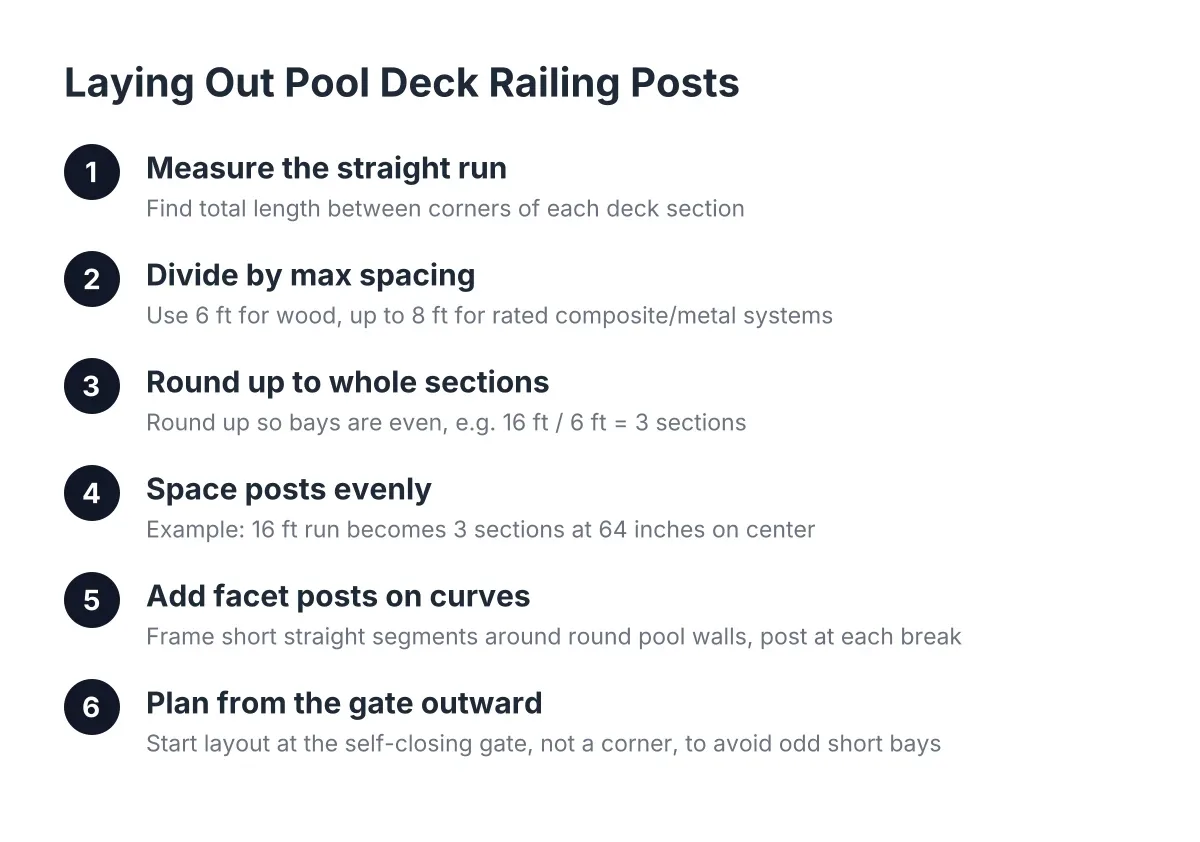
Deck railing installation succeeds or fails at the posts, not the infill. On a new build, the railing plan should be set before framing, so blocking goes in where posts land and stair geometry works out to code heights. On a replacement, the honest first question is whether the rim joists and existing posts are sound enough to anchor new railing, or whether rot underneath means the railing project is really a framing project.
Cost-wise, no single number covers Buffalo. The drivers are linear feet of railing, number of stair sections, material and system chosen, deck height, and how much structural correction the frame needs. For the deck as a whole, professionally built decks average $30 to $60 per square foot according to Angi, as reported by NerdWallet, and railing is one of the line items that pushes a project toward the upper end. Permits apply too; in Erie County, railing work tied to a new or rebuilt deck runs through your town's building department, and inspectors check guard height and post attachment specifically.
One clear limit here: if your existing railing wobbles, do not assume tightening bolts fixes it. Movement at the base often means hidden rot or a failed connection inside the framing, and that is worth a professional look before another winter loads it with snow.
How to Choose Between Wood, Composite, and Metal Railing
Work through it in this order:
- Measure your fall exposure. Under 30 inches above grade at every point, you have flexibility. Over it, especially on an elevated or multi-level deck, weight durability and stiffness heavily.
- Count your stairs. Multiple flights favor systems with matched stair kits, which means metal or major-brand composite.
- Be honest about maintenance. If you will not stain wood every two to three years, its price advantage disappears into repairs.
- Match the decking. Composite deck boards with a wood railing puts your maintenance burden right at the most visible, most grabbed part of the deck.
- Price the whole run, not per foot. A multi-level layout can carry double the railing footage of a flat deck the same size.
For most Buffalo homeowners building an elevated or multi-level deck in 2026, the comparison narrows to composite or aluminum, with wood staying in the conversation for low decks and tight budgets. All three can meet code on day one. The winter after installation is what separates them, and that is the test worth buying for.
If you need deck building, WNY Deck Builders can help.
Prefer to talk it through? Call (716) 317-4901 — a quick call is usually the fastest way to get a straight answer for your situation.