Trex, TimberTech, or Fiberon: Composite Deck Boards Ranked for Buffalo Winters
If your old wood deck is soft underfoot and you have already decided the replacement will be composite, the next question is which brand of composite deck boards actually holds up in Buffalo. Trex, TimberTech, and Fiberon all make good product. However, they behave differently through a Western New York winter, and the differences that matter here are not the ones the marketing pages talk about. This list ranks and compares the big three the way a deck builder would, with lake-effect snow, freeze-thaw cycles, and snow shovels in mind.
One note before the list. Brand matters less than most homeowners think, and framing matters more. The best composite deck boards in the world will fail early on a frame with heaved footings or rotted joists. In Buffalo, that means footings below the 42-inch frost line and framing sized for real snow load. Keep that in mind as you read.
1. Trex: The Name Everyone Knows, and a Solid Default
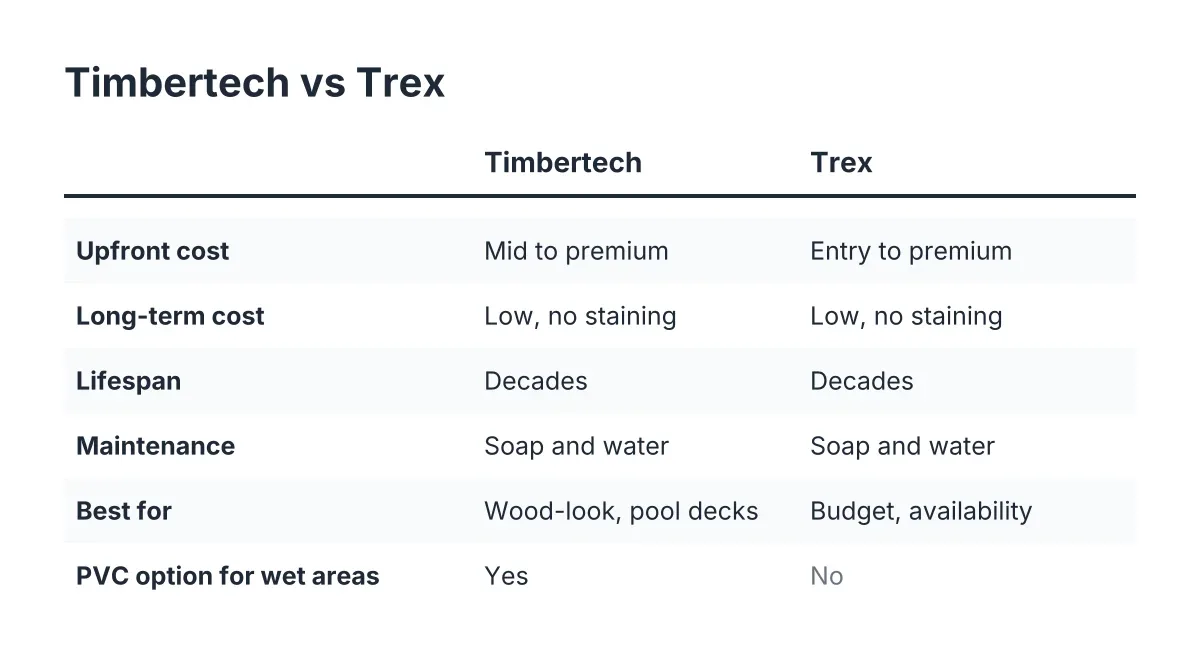
Trex composite decking is the brand most Buffalo homeowners ask for by name, and it earns the default spot. It is a capped composite, meaning a wood-plastic core wrapped in a protective shell that resists staining, fading, and moisture. For a straightforward backyard deck replacement, the mid-tier Trex lines handle WNY freeze-thaw well.
The trade-off is the entry-level line. Budget Trex boards are capped on three sides, not four, which leaves the bottom of the board exposed. On a low deck over damp ground with poor drainage, that matters more here than it does in a dry climate. If you go Trex on a deck close to grade, step up at least one tier.
2. TimberTech: The Strongest Pick for Snow, Shade, and Pool Decks
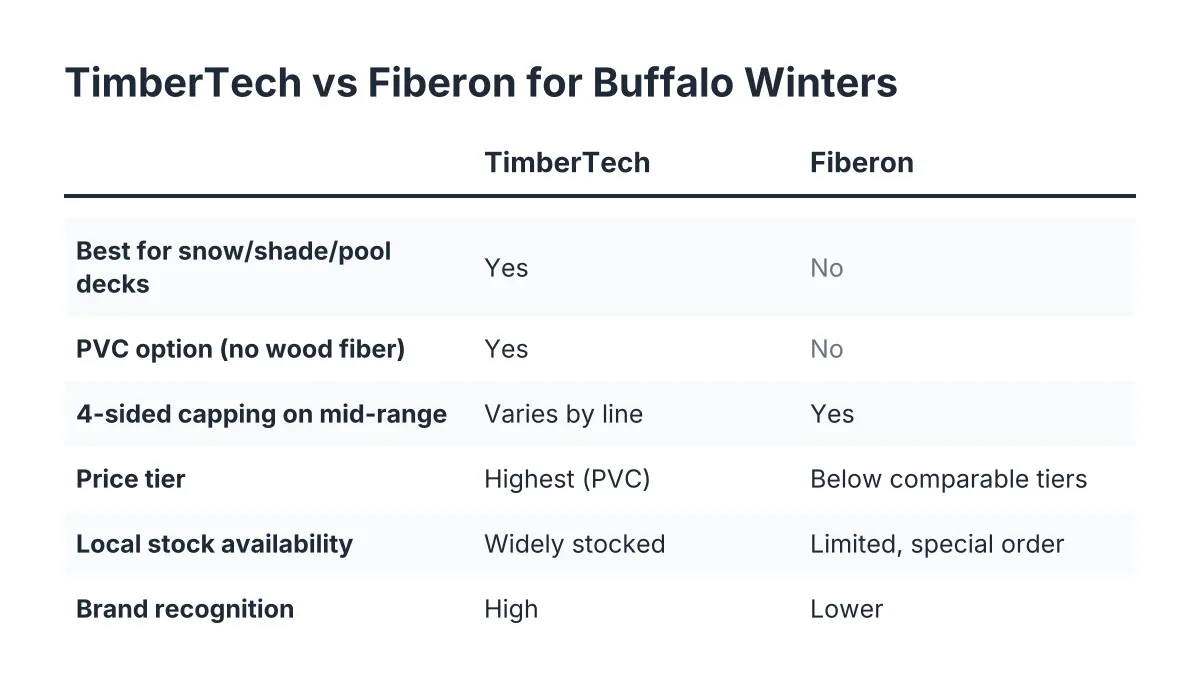
TimberTech earns the top performance spot for Buffalo conditions, mostly because of its PVC lines. TimberTech Advanced PVC decking has no wood fiber at all, so there is nothing in the board to absorb water, swell, or feed mold. For pool decks, shaded north-facing yards, and decks that sit under snow pack from December through March, that is the difference that shows up five winters in.
The catch is cost. Advanced PVC sits at the top of the price range, and for a sunny second-story deck with good drainage, TimberTech's capped composite lines deliver most of the benefit for less. A good deck builder will tell you when the PVC premium is worth it and when it is not.
3. Fiberon: The Value Play That Does Not Act Like One
Fiberon composite decking is the brand fewer homeowners know, and that gap works in your favor. Its mid-range boards are capped on all four sides in most lines, which helps on low decks and in the wet shoulder seasons Buffalo is famous for. Color and grain options are strong, and pricing tends to land under comparable Trex and TimberTech tiers.
The limitation is availability. Fewer local yards stock deep Fiberon inventory, so a specific color in 20 ft lengths may mean a special order and a longer lead time. If your rebuild is on a deadline, say before a graduation party in June, confirm stock before you commit to a color.
4. Rank the Board Line, Not the Brand Logo
Every one of these manufacturers sells a budget line, a mid line, and a premium line, and the spread inside one brand is wider than the spread between brands. A premium Fiberon board will outperform a budget Trex board in a Buffalo winter, and the reverse is also true. Comparing "Trex vs. Fiberon" without naming the line is how homeowners end up disappointed.
Therefore, when you collect quotes, make every contractor name the exact product line and cap coverage in writing. Ask three questions: Is the board capped on four sides? What is the fade and stain warranty term? Is this a scalloped or solid profile? Scalloped boards save money but flex more under point loads, like the legs of a hot tub or a loaded snow shovel.
5. Judge Composite Deck Boards by Freeze-Thaw, Not Brochure Photos
In Western New York, the real test of composite deck boards is not July. It is the forty-plus freeze-thaw cycles between November and April. Water works into any gap, freezes, expands, and pries. Capped composites resist this well; uncapped or partially capped boards on wet sites do not.
Snow removal matters too. All three brands tolerate a plastic shovel fine. A metal blade or an ice chipper will scar any composite surface, and that scar is permanent because you cannot sand composite like wood. Plan to shovel with plastic and let salt-free ice melt do the rest, whichever brand you pick.
6. Expect 25 to 50 Years From the Boards, Less From a Bad Frame
How long does composite decking last? With proper installation, composite deck boards from Trex, TimberTech, or Fiberon commonly carry 25-year to 50-year warranties, and the boards themselves routinely outlive the pressure-treated frame beneath them. The boards are rarely the first thing to fail on a composite deck in Buffalo.
This is the part that matters most for anyone replacing a rotting deck. Suppose a homeowner in Cheektowaga has a 20-year-old wood deck with spongy boards and a wobbly railing. A quick re-deck with composite over the old frame looks cheap on paper. However, if the joists are soft or the footings are above frost depth, that new surface rides on the same failing structure. In that scenario, the honest answer is usually a full tear-off: new footings at 42 inches, new framing sized for snow load, then the composite deck boards on top. Paying twice for decking because the frame failed first is the expensive version of saving money.
7. Price the Whole Deck, Not the Board
Composite costs more up front than pressure-treated wood, and all three brands follow that pattern. The useful comparison is total project cost over 20 years, where composite skips the staining, sealing, and board replacement that wood demands after every WNY winter. According to NerdWallet, the average cost to add a professionally built deck runs between $30 and $60 per square foot, and labor alone typically runs $15 to $35 per square foot per Angi's figures cited there.
Where your project lands in that range depends on a handful of drivers:
- Board line and brand tier (budget capped composite vs. premium PVC)
- Deck height and footing count, since 42-inch frost footings add excavation
- Railing choice, because composite and aluminum deck railing can rival the decking cost on small decks
- Demolition and disposal of the old deck
- Site access, slope, and drainage work
Note that 12 ft, 16 ft, and 20 ft board lengths price differently per foot, and a deck designed around stock lengths wastes less material. That is a deck design decision, not a brand decision.
8. Match the Brand Tier to Your Specific Deck, Not Someone Else's
The right pick depends on the deck you are actually building. A rough guide from the ground up:
- Low deck or patio deck near grade, damp yard: four-side capped boards; Fiberon mid-tier or TimberTech PVC.
- Pool deck or above ground pool deck: TimberTech Advanced PVC or another full PVC line; bare feet, splash water, and chlorine favor zero wood content.
- Sunny elevated deck with good airflow: mid-tier Trex or Fiberon capped composite; the drainage does half the protective work for you.
- Covered custom porch: mid-tier anything; the roof shelters the boards, so spend the savings on framing and railing.
For example, two neighbors in Tonawanda could both "build a Trex deck" and get wildly different results, one on a shaded low frame with entry-level boards and one on an open elevated frame with mid-tier boards. Same logo, different outcomes. The site decides, not the sticker.
9. Codes and Permits Apply No Matter Whose Boards You Buy
Brand choice does not change the rules. In 2026, a deck rebuild in Buffalo or the surrounding Erie County towns still needs a permit, footings below frost depth, and framing that meets local snow-load requirements. New York's residential code requires a 36-inch guard height once the walking surface sits more than 30 inches above grade, according to Mister Baluster, so most elevated decks need code-compliant railing regardless of decking material.
Composite also has its own installation rules the brands enforce through their warranties: specific gapping between boards for expansion, maximum joist spacing (often tighter for diagonal layouts), and approved fasteners. Skip those and the warranty that sold you on the brand can go away. This is one place where a deck builder who installs composite weekly earns the labor cost; if your frame inspection turns up rot or heaved footings, bring in a professional before anyone lays a single new board.
The Short Version
TimberTech's PVC lines take the top spot for wet, shaded, and pool-adjacent decks in Buffalo. Trex is the dependable default for standard decks when you buy at least mid-tier. Fiberon is the value pick with four-side capping, if you can get the boards you want locally. All three composite decking materials survive WNY winters when the line is right for the site and the frame under them is built for frost and snow. Rank the board line and the framing first; the logo comes third.
If you need deck building, WNY Deck Builders can help.
Prefer to talk it through? Call (716) 317-4901 — a quick call is usually the fastest way to get a straight answer for your situation.