Timbertech vs. Trex: Which Is Right for You?
Timbertech and Trex are the two composite decking brands Buffalo homeowners ask us about most, and the timbertech vs trex question usually comes down to feel versus familiarity. In short: Timbertech tends to win if you want boards that look and feel closer to real wood, with capped PVC options that shrug off standing water. Trex tends to win if you want a proven composite deck at a friendlier price point, with the widest availability and the most installers who know it cold. Both handle Western New York freeze-thaw cycles far better than pressure-treated lumber. Here is how they stack up when your money is on the line.
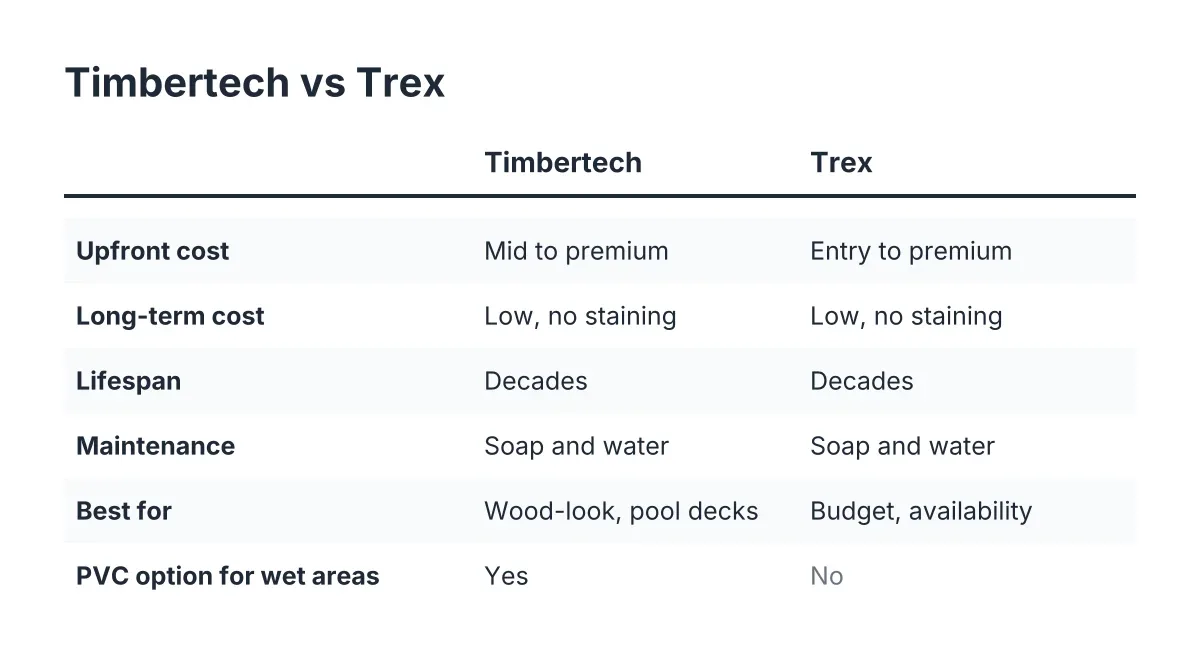
| Criteria | Timbertech | Trex |
|---|---|---|
| Upfront cost | Mid to premium tier, depending on line | Entry to premium tier, entry lines cost less |
| Long-term cost | Low; no staining or sealing | Low; no staining or sealing |
| Lifespan | Long; capped composite and PVC lines typically last decades | Long; capped composite lines typically last decades |
| Maintenance | Soap-and-water cleaning, no refinishing | Soap-and-water cleaning, no refinishing |
| Best for | Wood-look realism, PVC for pool decks and wet spots | Budget flexibility, wide availability, recycled content |
Timbertech: Strengths and Trade-offs
Timbertech makes capped composite and capped PVC decking. Capped means the board has a tough plastic shell bonded over the core, so water, snow melt, and spilled drinks stay on the surface instead of soaking in. The PVC lines have no wood fiber at all, which matters near water. For a pool deck or an above ground pool deck in WNY, where boards sit wet for months, that is a real advantage.
Where Timbertech shines is realism. Its upper lines carry varied grain patterns and multi-tone streaking that read as wood from the curb, not plastic. Homeowners who almost went with cedar usually land here. The trade-off is price. The lines people fall in love with sit at the premium end, and the budget lines lose some of that realism. If you priced a Trex entry board and a top Timbertech board side by side, the gap would surprise you.
The other trade-off is availability. Timbertech is stocked in fewer yards than Trex in some markets, so specific colors can mean a wait. A deck builder who plans the order early in the design phase avoids that problem, but it is worth knowing before you fall for a color sample.
Trex: Strengths and Trade-offs
Trex is the name most people know, and for good reason. It has been the default composite deck board for a long time, its entry lines are priced to compete with mid-grade wood over the life of the deck, and nearly every lumberyard in Western New York stocks it. Trex boards use a high share of recycled material, mostly reclaimed wood fiber and plastic film, which appeals to homeowners who care where their composite decking materials come from.
Trex's strength is range. You can build a patio deck on a tight budget with an entry line, or step up to a premium line with deeper grain and richer color blending. Because so many crews install Trex, hidden-fastener systems, matching deck railing, and trim pieces are easy to source and easy to get right.
The trade-offs are mostly at the entry level. Budget Trex boards have a more repetitive grain pattern and a narrower color range, and like most composites they get hot in direct summer sun, especially in dark colors. All of Trex's lines use a wood-plastic composite core rather than PVC, so for a pool deck that stays soaked, some builders lean toward a PVC board instead. None of this is a dealbreaker; it is just where the lower price shows.
Timbertech vs Trex: The Deciding Factors
Cost drivers
Trex usually wins on upfront cost at the entry level; the two brands overlap heavily in the middle and premium tiers. What actually moves your total in Buffalo is less the brand and more the board line you pick, the deck size and shape, railing choices, and the structure underneath. Our footings here go 42 inches deep to get below frost, and framing has to carry lake-effect snow load, so the substructure is a real share of the budget either way. For a fuller breakdown of what moves the number, see our guide to how much composite decking materials cost.
Lifespan
Call this one a tie; both brands' capped boards typically last decades with basic care. The cap is what matters in WNY. Freeze-thaw cycles destroy wood by driving water into the grain and expanding it; a capped board gives water nowhere to go. Timbertech's PVC lines have a slight edge in constantly wet spots because there is no wood fiber in the core to absorb anything, but for a typical backyard deck, both hold up.
Installation
Neither brand is harder to install, but the details under the boards decide how long your deck lasts. Both systems use hidden fasteners and both need correct gapping so boards can expand and contract through Buffalo winters and summers. Composite also flexes more than wood, so joist spacing has to match the board's specs, and drainage under the deck has to move snow melt away from the framing. That is builder work, not brand work. Any composite deck construction done right starts with the framing plan, permits, and footings, not the color sample.
Maintenance
Tie again: both need a soap-and-water wash once or twice a year and nothing else. No staining, no sealing, no sanding. That is the whole reason composite exists. The one habit that matters in WNY is snow removal; use a plastic shovel and skip metal edges so you never gouge the cap. Do that, and either brand looks close to new for a long time.
Situational fit
Pick by project, not by logo. Building a pool deck or a deck around an above ground pool? Timbertech's PVC lines handle constant water best. Working to a firm budget on a patio deck? Trex's entry lines get you into composite for the least money. Want the deck to pass for wood on a custom porch facing the street? Timbertech's premium lines are the stronger look. Want maximum choice in railing, trim, and local stock? Trex's availability makes life easier.
Which Should You Choose?
Choose Timbertech if:
- You are building a pool deck or any deck that stays wet, and want a PVC option with no wood fiber in the core
- Wood-look realism matters, and you would rather pay more for boards with varied grain and color
- You are planning early enough that ordering a specific line and color is not a scheduling problem
- Your project is a front porch or a showpiece deck where the surface is the first thing people see
Choose Trex if:
- You want composite decking on the tightest workable budget without giving up the low-maintenance benefit
- Local availability matters; you want boards, railing, and trim stocked nearby and easy to match later
- Recycled content is a priority for you
- You want the brand most crews in Western New York have installed many times before
If you are still stuck, here is the honest tiebreaker we give homeowners over the fence: match the board to the wettest, harshest spot on your deck. If that spot is a pool edge or a shaded corner that holds snow into April, lean Timbertech PVC.Additionally, if it is an ordinary backyard deck, lean Trex and put the savings into better railing or a bigger footprint.
Common Questions
Does one brand handle Buffalo winters better than the other?
Both handle freeze-thaw far better than wood because the cap keeps water out of the board. The bigger winter question is under the deck: footings below the 42-inch frost line, framing sized for lake-effect snow load, and drainage that moves melt water away. Get those right and either brand survives WNY winters.
Is Timbertech or Trex cheaper?
At the entry level, Trex usually costs less. In the middle and premium tiers the brands overlap, and the total swings more on deck size, railing, site conditions, and structure than on the logo on the box. Ask for material pricing on two or three specific lines rather than a brand-versus-brand number.
Can I mix brands, or switch later if I change my mind?
You should pick one brand per deck surface, since colors, fastener systems, and trim pieces are designed to work within a line. When weighing timbertech vs trex options, decide before the framing plan is final so joist spacing and fastener choices match the board. Switching later usually means replacing all the decking, though the framing underneath can often stay.
Which is better for a pool deck?
A PVC board, which points toward Timbertech's PVC lines for most pool decks. PVC has no wood fiber to absorb splash water, so it handles a surface that stays wet all season. For a patio deck or a standard backyard deck away from water, both brands' capped composite boards work well.
If you need deck building, WNY Deck Builders can help.
Prefer to talk it through? Call (716) 317-4901 — a quick call is usually the fastest way to get a straight answer for your situation.