
Deck Railing Installation — Complete Guide
Your deck railing does more than frame the view. It keeps your family safe, determines whether your deck passes inspection, and decides how much maintenance you sign up for every Western New York winter. This guide walks you through deck railing ideas that actually work in Buffalo, from material choices that shrug off lake-effect snow to the code height requirements Erie County inspectors check first. You will also learn how to tell whether your existing railing needs a simple fix or a full replacement, and what the work typically costs. If you are planning a new deck or replacing a rotting one, this page gives you the full picture before you spend a dollar.
What You'll Find in This Guide
Popular Deck Railing Ideas for Buffalo Winters
The best railing material for winter in Western New York is the one that ignores moisture. Freeze-thaw cycles, lake-effect snow piling against posts, and months of trapped meltwater destroy railings faster than sun or foot traffic ever will. With this in mind, evaluate every material against one question: what happens when it stays wet from November through April?
Composite, Aluminum, and PVC: The Low-Maintenance Options
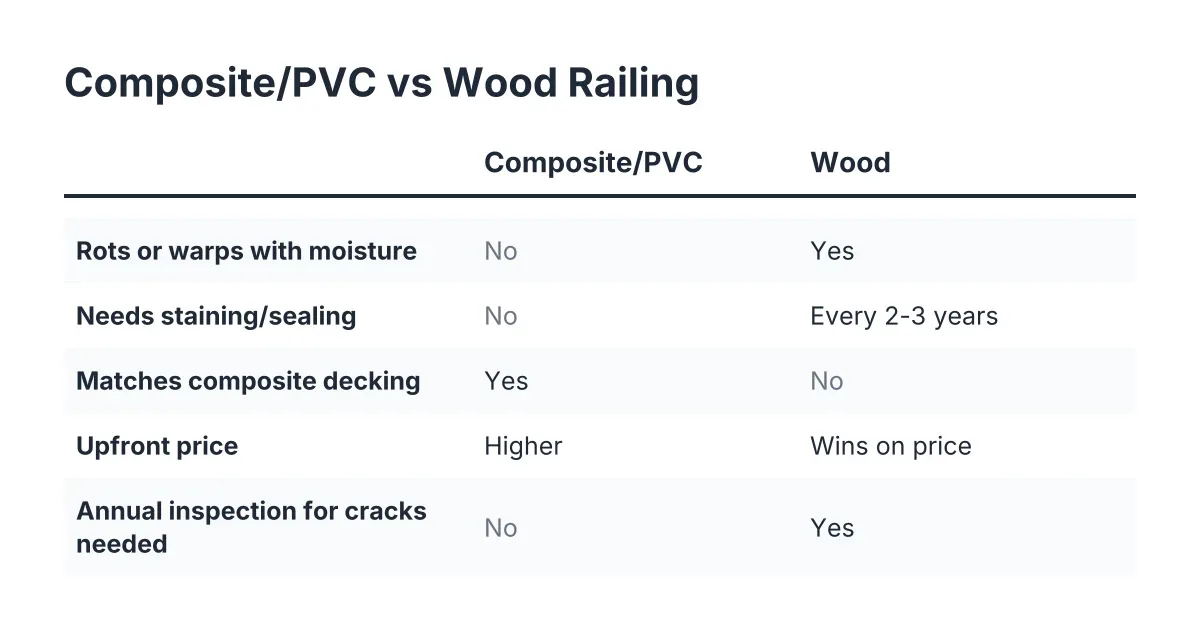
Composite railing pairs naturally with composite decking, and it handles Buffalo winters well. It will not rot, it never needs staining, and the color holds up under snow load and UV exposure. Aluminum railing goes a step further. Because it is metal with a powder-coated finish, it sheds moisture completely and offers slim profiles that preserve your view. PVC railing behaves similarly to composite, with hollow profiles that resist water absorption entirely. For most homeowners replacing a rotted wood railing, one of these three materials ends the maintenance cycle for good.
Cable, Glass, and Wood: Style Choices With Trade-Offs
Cable railing has become one of the most requested deck railing ideas for homes with a view, and the composite vs cable railing decision usually comes down to sightlines versus budget. Cable systems cost more per linear foot, and the stainless cables need periodic re-tensioning. However, they open up your backyard visually in a way pickets never will. Glass panels offer similar openness but demand cleaning, and snow spray off Lake Erie will coat them quickly. Wood remains the budget option, yet in this climate it demands annual sealing and still fails first at the post bases where snow sits longest.
That said, material choice affects more than looks and upkeep. It also drives your budget significantly, which is why our deck railing installation cost guide breaks pricing down by material and linear foot. Read it before you fall in love with a system that doubles your project cost.
Railing Height and Code Requirements in Erie County
Before you pick a style, you need to know whether your deck legally requires a railing at all. New York's residential code answers that question based on height above grade, and inspectors in Buffalo, Amherst, Cheektowaga, and the surrounding towns enforce it consistently.
The 36-Inch Rule and When It Applies
Here is the threshold that matters. According to Mister Baluster, New York's residential building code requires a 36-inch guard height once a deck's walking surface sits more than 30 inches above grade. In practice, this means a low patio deck a step off the ground may not need a guard at all. Meanwhile, an elevated deck off a second-story door absolutely does, and the inspector will measure it. Baluster spacing matters too. Openings cannot allow a 4-inch sphere to pass through, a rule written specifically to protect small children. Stairs carry their own requirements for graspable handrails, which trip up more DIY builders than any other detail.
If you want to read the source language yourself, the New York State Department of State publishes the Uniform Code that Erie County municipalities enforce.
Why Older Decks Fail Modern Code
Many Western New York decks built in the 1980s and 1990s carry 32-inch or 34-inch railings. Those passed inspection at the time. However, once you replace the railing or rebuild the deck, the new work must meet current code requirements. This surprises a lot of Rotting Deck Replacers who assumed they could swap materials and keep the old dimensions. Beyond height, older railings often fail on attachment strength. Modern code expects a guard to resist a concentrated load, which means posts bolted through the rim joist with proper hardware, not toenailed to the decking. As a result, a railing replacement on an older deck often includes structural blocking work you cannot see from above. Factor that into your budget early, because it changes the installation cost more than the material you choose.
New Installation vs. Fixing a Loose or Failing Railing
Homeowners come to railing projects from two directions. Some are planning a brand-new deck and choosing a system from scratch. Others have an existing deck with a railing that wobbles, rots, or fails the shake test. The right move depends on what is actually failing underneath.
When a Loose Railing Is a Repair, Not a Replacement
A deck railing loose fix is sometimes genuinely simple. If the posts are sound and the wood is dry, the problem may be nothing more than fasteners that worked loose through years of freeze-thaw movement. In that case, replacing lag screws with through-bolts and adding blocking between joists restores a solid rail. However, wobble is often a symptom, not the disease. For example, a post that moves at the base frequently hides rot inside the rim joist where water pooled for years. Probe the wood with a screwdriver. If it sinks in easily, the framing has failed and no amount of new hardware will fix it. On decks more than 15 years old, we find hidden rim joist rot behind loose railings more often than not.
Choosing Replacement on New Decks and Rebuilds
For a new deck, railing selection should happen during design, not after framing. This is because post placement, stair layout, and even joist spacing change depending on the railing system you choose. Cable railing needs stronger corner posts to handle tension. Aluminum systems have fixed panel widths that dictate post spacing. Additionally, if you are replacing a whole rotting deck rather than just the rail, integrating the railing decision into the design saves money. You avoid paying twice for structural work, and you can browse deck railing ideas with real dimensions in hand instead of guessing. Either way, get a real number before you commit. Our cost guide for deck railing installation explains how length, material, and structural condition combine into an honest price, so you can compare a repair quote against a replacement quote with clear eyes.
Whichever path fits your deck, the goal stays the same. You want a railing that meets code, anchors solidly to sound framing, and does not become an annual maintenance chore. To put it simply, solve the structure first, then pick the style.
Ready to Get Started?
If you are weighing deck railing ideas for a new build or staring at a wobbly rail you no longer trust, we can help you sort it out. Our team designs and installs railing systems built for Western New York winters, sized to code, and anchored to framing that will hold. Reach out for a straight answer on what your deck needs and what it will cost.