Deck Lighting Ideas That Survive Buffalo Winters: String Lights vs. Solar
Most deck lighting ideas you find online come from photo galleries shot in Arizona or the Carolinas. They look great in June. Then a Buffalo January arrives, the solar panels sit under eight inches of lake-effect snow, the plastic string light clips go brittle at ten degrees, and by spring half the setup is dead. If you are planning a new deck or pool deck in Western New York, or replacing one that finally rotted out, the question is not which lights look best. The question is which lights are still working after two freeze-thaw cycles.
The big head-to-head for most homeowners is string lights versus solar deck lights. Both are cheap to start with. Both fail in specific, predictable ways up here. So here are seven lighting and feature choices, ranked by how they actually hold up in WNY weather, with the honest trade-offs a deck builder sees after a few winters.
1. Outdoor String Lights: Great Look, Short WNY Lifespan Unless You Buy Right
String lights are the most popular deck lighting idea in America, and they earn it. They throw warm, even light over a whole patio deck, they cost less than almost any other option, and they go up in an afternoon. The problem in Buffalo is not the light. It is the hardware.
Cheap string lights use thin-gauge wire and plastic sockets that crack in a freeze-thaw cycle. Snow load matters too; a strand sagging under wet lake-effect snow puts real tension on its anchor points. If those anchors are screwed into a fascia board that is already soft, the whole run comes down.
If you go with string lights in WNY, three things change the outcome:
- Buy commercial-grade strands with 14-gauge or heavier wire and molded sockets, rated for cold-weather outdoor use.
- Anchor to solid framing or a dedicated cable, never to trim boards or an old railing you have not checked for rot.
- Run them on a switched, GFCI-protected exterior circuit, not an extension cord snaked through a window.
Do that, and string lights can last five or more winters. Skip it, and you are rebuying them every spring.
2. Solar Deck Lights: Honest About What They Can and Cannot Do Here
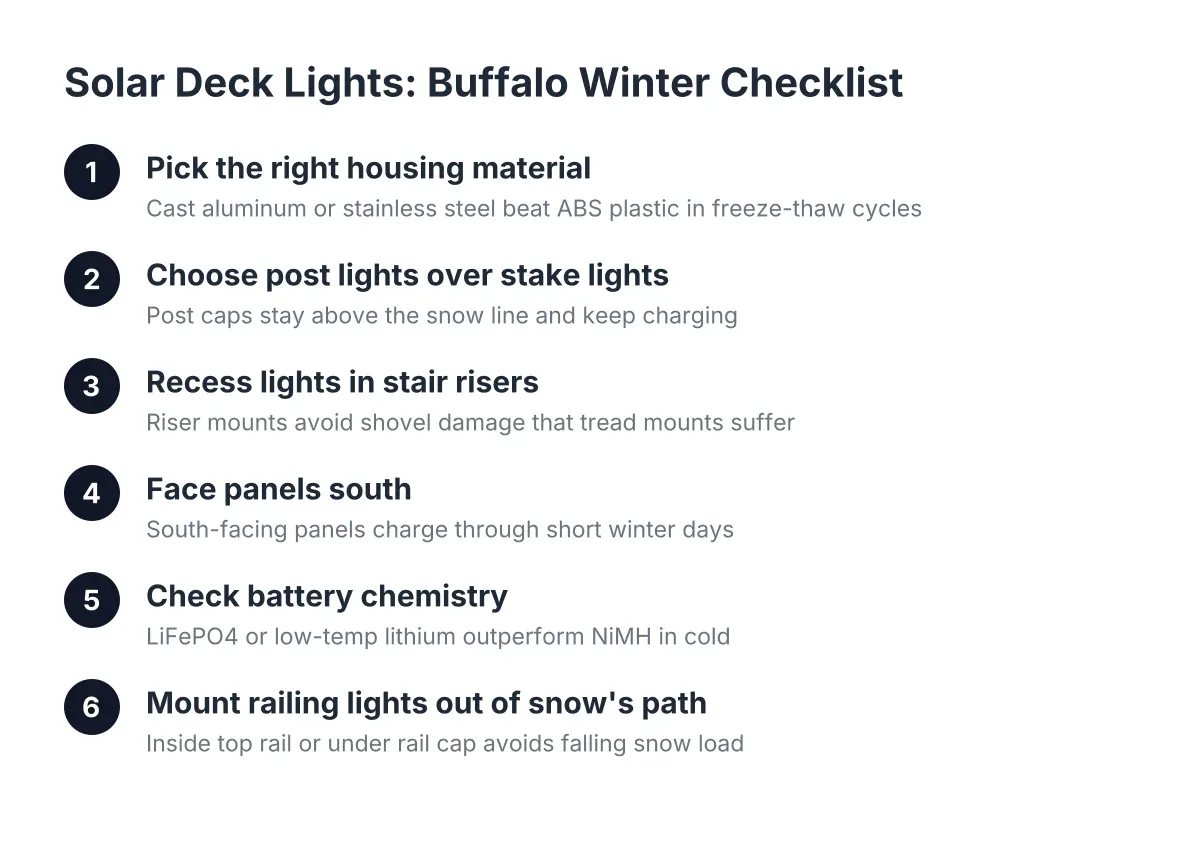
Solar deck lights are the low-commitment option, and in Western New York they come with a catch nobody prints on the box. From November through February, Buffalo gets some of the shortest, cloudiest days in the country, and panels spend weeks under snow. A solar post cap that glows for eight hours in July might manage ninety dim minutes in January, if it charges at all.
That does not make solar useless. It makes it seasonal. For a pool deck you only use from Memorial Day to Labor Day, solar deck lights are a fair match; the lights work exactly when the deck does. For year-round task lighting on stairs you shovel all winter, solar is the wrong tool.
One more durability note: buy solar fixtures with replaceable batteries. Sealed units usually die in two to three seasons because the battery fails long before the LED does, and then the whole cap goes in the trash.
3. Low-Voltage Wired Lighting: The Best Deck Lighting Ideas for Winning Winter
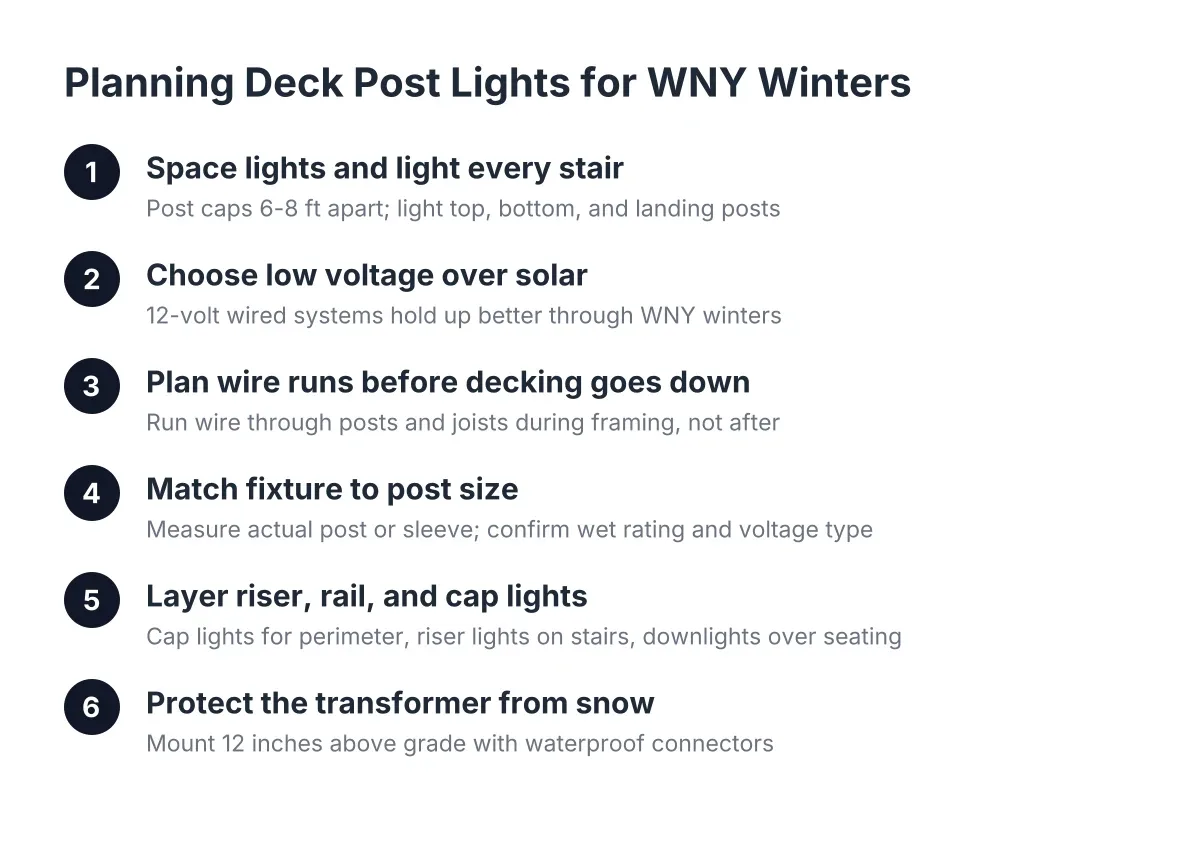
If you want one takeaway from this list, it is this. Low-voltage wired lighting, meaning a 12-volt system run off a transformer, beats both string lights and solar for Buffalo conditions. The fixtures are metal or heavy composite, the wiring is buried or tucked under the deck framing, and the output does not care whether the sun showed up that week.
The reason it belongs in a planning article, not just a shopping list, is timing. Wiring is cheap and clean to run while a deck is being framed. Retrofitting it under a finished deck means crawling, drilling, and fishing wire through joists. Suppose a homeowner in Cheektowaga is replacing a rotted deck this spring; asking the deck builder to rough in low-voltage runs during framing might add a few hundred dollars in labor. Asking for the same thing two years later can cost several times that. Those figures are illustrative, but the ratio holds on almost every job.
Low-voltage systems also handle stair and rail lighting, which brings us to the safety items.
4. Recessed Stair Lights: The One Feature That Earns Its Keep in the Dark Months
Buffalo sits in the dark by 5 p.m. from November through January. If your deck stairs get used at all in those months, to reach a grill, a hot tub, or the back gate, stair lighting is a safety feature first and a design feature second. Ice on an unlit tread is how people get hurt on otherwise sound decks.
Recessed riser lights, wired into a low-voltage system, sit flush so a snow shovel passes right over them. Surface-mounted fixtures on stairs tend to get clipped by shovels and snowblowers within a winter or two. If you are already replacing a failing deck, this is the moment to build lighting into the new stringers instead of bolting it on later.
There is a code angle too. Under New York's residential code, any deck surface more than 30 inches above grade needs a 36-inch guard, according to Mister Baluster. Once you are building compliant railings and stairs anyway, adding wired lighting to those same posts is a small incremental step.
5. Post Cap Lights: Wired Lighting Ideas for Railings You Count On
Deck post cap lights split into the same two camps, solar and low-voltage wired, and the same winter logic applies. Solar caps are fine as accent glow on a summer pool deck. Wired caps are the choice for railings that mark a stair edge or the perimeter of an elevated deck, where you want light every night, not just after sunny days.
Materials matter as much as power. Look for caps with metal housings and gasketed seals. Thin plastic caps take UV damage all summer, then crack when water gets into a seam and freezes. On composite deck railings, most manufacturers offer matched lighted caps that install cleanly during railing installation; that is another feature far easier to plan during the build than to add after.
For a pool deck specifically, perimeter post lighting does double duty. It defines the deck edge at night, which matters when kids are moving between the pool, the ladder, and the yard.
6. Built-In Benches and Planters: Features That Double as Lighting Mounts
Built-in benches and planters show up in every backyard ideas roundup, and they belong in a lighting article for one reason: they are the best hidden mounting points on a deck. A strip of LED under a bench lip washes light across the decking without a single visible fixture. A planter box can hide a low-voltage junction that feeds half the deck.
However, built-ins carry a WNY-specific caution. Planters hold wet soil against decking and framing for months, and trapped moisture is exactly how wood decks rot. If you are replacing a deck that failed from rot, do not rebuild the same trap. Use planter liners with drainage, keep an air gap between the planter and the deck surface, and lean toward composite deck boards under and around them. Benches should be framed into the deck structure during construction so they do not wobble the way surface-bolted seats do after a few freeze-thaw seasons.
7. Pergolas and Privacy Screens: Structures That Carry Lights, and Snow
A pergola attached to a deck is the natural home for string lights, and a privacy screen gives you a wall for sconces or backlighting. Both work in Western New York, with one non-negotiable: they have to be engineered for snow load and wind, not just copied from a plan drawn for a milder climate.
An attached pergola transfers load to the deck framing and, through it, to the footings. In Erie County that means footings at frost depth, 42 inches, and framing sized for the snow our lake-effect bands drop. A privacy screen acts like a sail in wind off the lake; its posts need real footings, not surface brackets. This is the point where deck lighting and features stop being a shopping decision and become a structural one, and where permits and code compliance planning enter the picture. If a feature attaches to the deck frame, have someone who builds decks for a living confirm the framing and footings can carry it; that is not a corner worth cutting on guesswork.
Choosing Deck Lighting Ideas for WNY
The right deck lighting for a Buffalo home depends on when you use the deck. Choose commercial-grade string lights for summer ambiance on a covered patio deck. Choose solar deck lights only for seasonal accent use, like a pool deck that closes in September. Additionally, Choose low-voltage wired lighting for anything you rely on year-round, especially stairs and railings.
A quick decision path:
- Deck used only in summer, and you want atmosphere: heavy-gauge string lights on solid anchors, or solar accents.
- Above ground pool deck on a seasonal schedule: solar post caps plus one wired fixture at the ladder or stair entry.
- Year-round use, stairs, or an elevated deck: low-voltage wired stair and post lighting, roughed in during framing.
- Replacing a rotted deck in 2026: plan the lighting now, while the framing is open, even if you install fixtures later.
The pattern across all seven items is the same. In Western New York, durability is a planning decision, not a product decision. The homeowner who thinks about pathway lighting, wire runs, and snow load before the first footing is poured gets landscape lighting and deck features that still work in year five. The one who shops for deck lighting ideas after the boards are down gets whatever can be bolted on, and bolted-on is what winter takes first.
If you need deck building, WNY Deck Builders can help.
Prefer to talk it through? Call (716) 317-4901 — a quick call is usually the fastest way to get a straight answer for your situation.