Deck Lighting and Features Terms Explained: A Plain-English Glossary
If you are pricing out a new deck in Buffalo or Western New York, the lighting and add-on line items on a quote can read like another language. This deck lighting and features glossary translates those terms into plain English so you can read a proposal line by line, ask a deck builder sharper questions, and spot gaps before the work starts. Each entry gives you a short, standalone definition first, then explains why it matters for your project and your budget. Nothing here requires a construction background.
- Low-Voltage Lighting: safer, cheaper-to-run deck lighting
- Line-Voltage Lighting: full household power outdoors
- Post Cap Lights: lights built into railing post tops
- Riser Lights: small lights set into stair faces
- Recessed Deck Lights: flush lights set into the deck surface
- Under-Rail Lighting: hidden strips beneath the handrail
- Solar Deck Lights: sun-charged, no-wiring lights
- String Lights: overhead bulbs on a wire or cable
- Transformer: the box that steps power down
- GFCI Outlet: a shock-protecting outdoor outlet
- Wet-Rated vs. Damp-Rated: how much weather a fixture can take
- IP Rating: a fixture's dust and water score
- Built-In Bench Seating: seating framed into the deck
- Privacy Screen: a wall-like panel for screening views
- Pergola: an open-roof overhead structure
- Skirting: the panel that hides the space under a deck
- Electrical Rough-In: wiring run before surfaces close up
- Load Calculation: checking the circuit can handle the lights
Deck Lighting Types and Features
These are the terms you will see most often when a quote lists deck lighting and features, and they describe where the light sits and how it gets power. Knowing the difference helps you tell a decorative add-on from a safety item.
Low-Voltage Lighting
Low-voltage lighting is a deck lighting system that runs on stepped-down power, usually 12 volts, instead of full household current. It is the standard choice for most deck lighting because the wiring is safer to run, the fixtures stay cool, and the electricity cost is small. For a Buffalo deck, low-voltage systems also handle freeze-thaw cycles well since the fixtures carry less heat stress. If a quote says "low-voltage package," it usually includes a transformer, wiring, and a set of fixtures priced together.
Line-Voltage Lighting
Line-voltage lighting means fixtures that run on full 120-volt household power, the same as the outlets inside your house. It is brighter and can power bigger fixtures, but it usually requires a licensed electrician and buried, protected wiring. On a deck project, line voltage shows up for overhead fixtures, ceiling fans on a custom porch, or outlets. Expect it to add both cost and permit steps compared to low-voltage runs.
Post Cap Lights
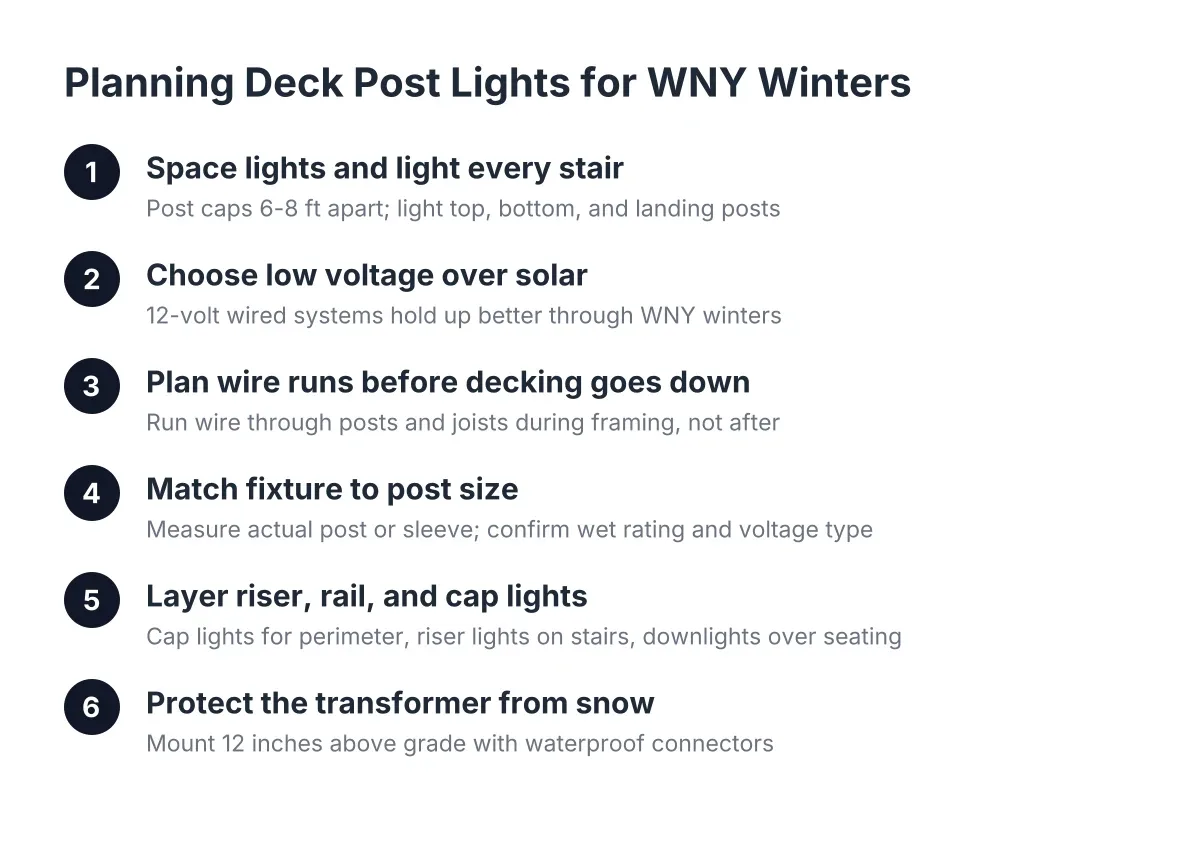
Post cap lights are fixtures built into the caps that sit on top of deck railing posts. They mark the edge of the deck at night, which matters on an elevated deck or around stairs. Because they replace a standard post cap, they are one of the easier lighting upgrades to add during deck railing installation. Adding them later means rerunning wire through finished posts, so it costs less to decide up front.
Riser Lights
Riser lights are small fixtures set into the vertical face of a stair step, the part called the riser. Their whole job is safety: lighting each step so nobody misses one in the dark. In Western New York, where snow and early darkness are facts of life from November on, stair lighting is one of the most practical features you can add. A builder who suggests riser lights on an elevated deck is thinking about how you will use the stairs in December, not just July.
Recessed Deck Lights
Recessed deck lights are small fixtures set flush into the deck boards themselves, so nothing sticks up above the walking surface. They give a soft glow along walkways and edges without creating a trip hazard. On a composite deck, the installer cuts openings and wires them before the boards go down, so these belong in the original plan. They work well around a pool deck perimeter where bare feet and hardware do not mix.
Under-Rail Lighting
Under-rail lighting means LED strips or small fixtures mounted beneath the top rail of a deck railing, aimed down at the deck surface. The light source stays hidden, so you see the glow but not the bulb. It is popular on composite decks because the strips tuck into the railing profile cleanly. If your quote includes it, ask where the wiring runs and how a damaged strip section gets replaced.
Solar Deck Lights
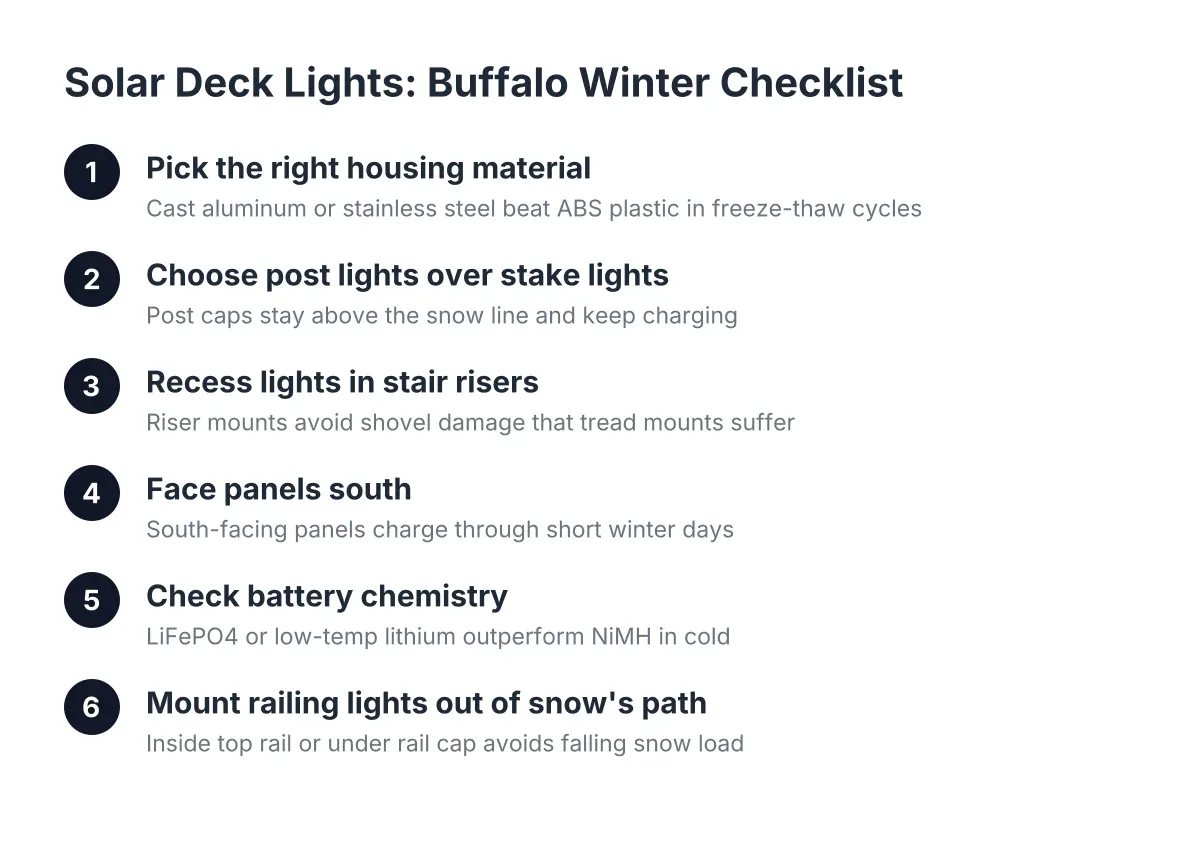
Solar deck lights are fixtures with a small built-in panel and battery that charge from sunlight and switch on at dusk, with no wiring at all. They cost less to install than wired lights, but output drops in winter when Buffalo gets short, gray days. They suit accent spots better than stairs or main walkways. For a full comparison of how each option holds up here, see string lights vs. solar for Buffalo winters.
String Lights
String lights are strands of bulbs hung overhead across a deck, usually anchored to posts, a pergola, or the house. They give broad, warm light for a low price and set the tone for evening use. The catch in WNY is weather: strands need rated outdoor bulbs, solid anchor points, and enough slack to handle wind and snow load on whatever they hang from. A builder may suggest dedicated posts so the strands do not pull on your railing.
Power, Wiring, Safety, and Deck Lighting Features Glossary
This is the part of the quote where jargon does real work. These terms tell you whether the electrical side of the job is planned properly.
Transformer
A transformer is the box that steps household 120-volt power down to the 12 volts a low-voltage lighting system uses. It plugs into an outdoor outlet or gets hardwired, and every low-voltage fixture on the deck runs off it. Transformers are sized in watts, so the total of all your fixtures has to fit within its capacity. If you plan to add more lights later, ask your deck builder to size the transformer with room to grow.
GFCI Outlet
A GFCI outlet is a ground-fault circuit interrupter, an outlet that shuts power off instantly if it detects electricity leaking where it should not go, such as through water or a person. Outdoor outlets on decks are required to be GFCI-protected under standard electrical rules; check your local code for specifics. On a pool deck or above ground pool deck, this protection is non-negotiable. If a quote includes outdoor outlets without mentioning GFCI, ask.
Wet-Rated vs. Damp-Rated
Wet-rated and damp-rated are fixture classifications that describe how much direct water exposure a light can handle. Wet-rated fixtures can take rain and snow hitting them directly; damp-rated fixtures need cover, like a porch ceiling. On an open Buffalo deck that sees lake-effect snow sitting on it for months, exposed fixtures should be wet-rated. A custom porch ceiling fixture can be damp-rated because the roof shields it.
IP Rating
An IP rating is a two-digit score, short for ingress protection, that tells you how well a fixture resists dust and water. The first digit covers solids like dust, and the second covers water, with higher numbers meaning tighter sealing. You will see it on fixture spec sheets rather than quotes, but it is the number behind claims like "weatherproof." For anything at snow level on a WNY deck, higher water ratings mean fewer dead fixtures come spring.
Electrical Rough-In
Electrical rough-in means running wires, boxes, and conduit while the deck framing is still open, before decking and railing close everything up. It is the cheapest moment to add lighting, outlets, or a line for a future hot tub, because nothing has to be torn apart. A deck builder who asks about lighting during the design stage is protecting you from paying twice. Decide on deck lighting and features before framing starts, even if some fixtures get installed later.
Load Calculation
A load calculation is the math that confirms a circuit or transformer can safely power everything connected to it. Every light, outlet, and fan draws watts, and the total has to stay within what the wiring is rated to carry. It sounds technical, but the takeaway is simple: someone should add up the numbers before adding fixtures. Lighting costs also scale with how much wiring and capacity the plan needs; the factors are laid out in this deck lighting and features cost guide.
Built-In Features and Structures
Built-In Bench Seating
Built-in bench seating means benches framed directly into the deck structure instead of placed on top as furniture. They save space, never blow over in a Lake Erie wind, and can double as a partial barrier along a deck edge. Because they attach to the framing, they need to be in the plan before construction, not after. Note that on an elevated deck, a bench near the edge may change what railing height the code requires; check your local code.
Privacy Screen
A privacy screen is a wall-like panel, often lattice, slats, or solid boards, built along one side of a deck to block a sightline or the wind. In tight Buffalo lots where neighbors sit close, a screen can matter more than any light fixture. Screens catch wind, so they need proper posts and footings, not just surface attachment. A builder who talks about footings for your screen is doing it right.
Pergola
A pergola is an open overhead structure with posts and cross beams but no solid roof. It defines an outdoor room, gives string lights and shade fabric something to hang from, and frames the deck visually. In Western New York, a pergola has to be designed for snow load even though it has no roof, because snow bridges across the beams. Pergola posts also usually need their own frost-depth footings, which adds to structural cost.
Skirting
Skirting is the material, often lattice or matching deck boards, that closes off the open space between the deck surface and the ground. It hides posts and framing, keeps animals out from under the deck, and finishes the look. Good skirting still lets air move so the framing underneath can dry, which matters in a freeze-thaw climate. Solid skirting with no ventilation traps moisture and shortens the life of the framing behind it.
Using These Terms
You now have the vocabulary to read a lighting and features quote line by line instead of skimming past the parts you did not recognize. When a proposal lists a transformer size, a GFCI outlet, or wet-rated fixtures, you will know what each item is doing and what its absence might mean. That is the point of this deck lighting and features glossary: fewer surprises, better questions, and a plan that fits a Buffalo winter as well as a July evening.
If you need deck building, WNY Deck Builders can help.
Prefer to talk it through? Call (716) 317-4901 — a quick call is usually the fastest way to get a straight answer for your situation.