
Deck Staining and Sealing — Complete Guide
Your deck's finish is the only thing standing between the wood and a Buffalo winter. Staining and sealing on the right schedule keeps water out of the boards, and dry boards do not rot. This guide covers how often to stain, which sealers hold up in a cold climate, how deck stain colors affect durability, and the cleaning routine that gets your deck through lake-effect season intact. We build and repair decks across Western New York, so this advice comes from seeing exactly which finish failures turn into rot calls, not from a paint brand's marketing page. Read on and you will know what to do, when to do it, and what it should cost.
What You'll Find in This Guide
How Often to Stain and Seal a Deck in Western New York
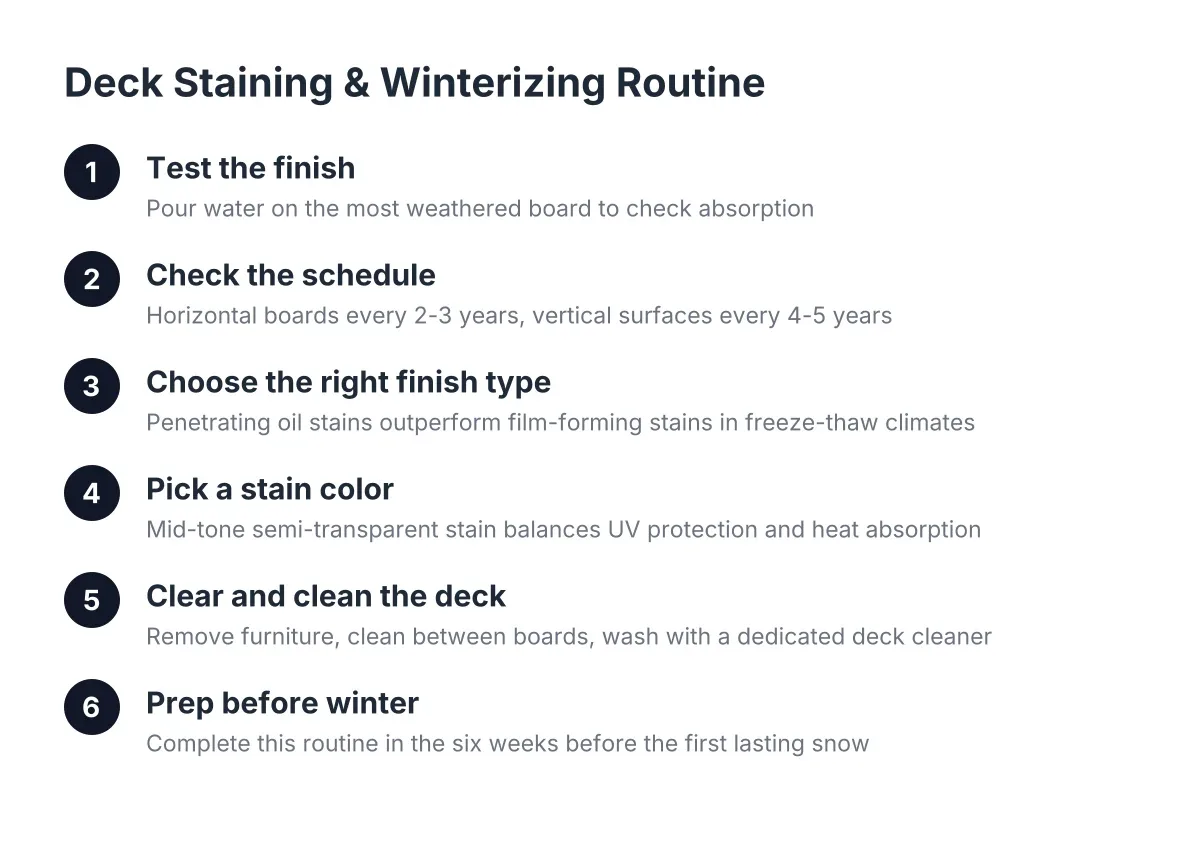
The honest answer for most wood decks in Buffalo is every two to three years. However, that range depends on sun exposure, foot traffic, and how well the last coat was applied. A south-facing deck that bakes all summer and then sits under snow all winter will need attention sooner. Meanwhile, a shaded deck with good drainage might stretch closer to four years between full recoats.
Do not wait for a calendar reminder. Instead, test the wood every spring. Pour a few tablespoons of water on the most exposed board. If the water beads up and sits on the surface, your sealer is still working. If the water soaks in and darkens the wood within a minute or two, the finish has failed and moisture is already getting into the boards. That soaked-in water is what freezes, expands, and splits the grain when temperatures drop.
Why WNY Decks Fail Faster Than the Label Says
Stain manufacturers test their products in controlled conditions. Your deck lives through something different. Lake-effect snow can sit on horizontal boards for months, keeping them wet far longer than decks in drier climates. Then spring arrives with dozens of freeze-thaw cycles that pump moisture in and out of every crack. As a result, a finish rated for five years often gives you two or three here.
Horizontal surfaces take the worst of it. Deck boards, stair treads, and railing caps hold standing water and snow, so they wear out first. Vertical surfaces like railings, balusters, and skirting shed water and can often skip a cycle. For this reason, many WNY homeowners recoat the walking surface every two years and do the full deck every four. That split schedule saves money without letting the most vulnerable wood go unprotected.
Cost is the other half of the timing question. Prep work drives the price more than the stain itself, and a deck that went too long between coats needs more prep. Our deck staining and sealing cost guide breaks down what size, condition, and prep each add to the bill. To put it simply, staining on schedule is cheaper than staining late, and both are far cheaper than replacing rotted framing.
Choosing Deck Stain Colors and Sealers Built for Cold Climates
Product choice matters as much as timing. In a freeze-thaw climate, you want a finish that flexes with the wood instead of cracking on top of it. That rules out most film-forming products for horizontal surfaces. Solid stains and deck paints form a skin over the board. When ice lifts that skin even slightly, water gets underneath and the peeling starts. Once a film finish peels here, you face full stripping before you can recoat.
Penetrating oil-based and hybrid stains soak into the wood rather than sitting on it. Consequently, they fade instead of peel, and recoating means cleaning and reapplying rather than sanding and stripping. For Buffalo decks, a semi-transparent penetrating stain with a water repellent built in is the workhorse choice. Look for products labeled for freeze-thaw or northern climates, and check that the sealer component blocks both water and UV. Water causes rot, but UV breaks down the lignin in the wood surface, and gray, degraded fibers will not hold the next coat of stain.
How Deck Stain Colors Affect Durability, Not Just Looks
Deck stain colors do real work beyond curb appeal. Pigment is UV protection. Clear sealers offer almost none, which is why a clear-coated deck grays out in a single season. Semi-transparent stains carry moderate pigment and typically protect for two to three years here. Solid colors carry the most pigment and the most UV defense, but on walking surfaces they behave like paint and peel under freeze-thaw stress.
Darker deck stain colors also absorb more heat. In practice, that helps snow melt off the boards faster in early spring, though it makes the surface hotter in July. Lighter tones stay cooler underfoot around a pool deck but show dirt and tannin bleed sooner. There is no single right answer. Instead, match the pigment level to the surface: semi-transparent on deck boards and treads, solid color on vertical railings and skirting if you want a bolder look that will not peel underfoot.
One more note on value. According to NerdWallet, homeowners recover 89% of the cost of a new wood deck when they sell, per the National Association of Realtors' 2023 Remodeling Impact Report. A well-maintained finish protects that resale value. A gray, splintered, peeling deck erases it.
Staining a New Pressure Treated Deck: Timing Is Everything
New deck owners make one mistake more than any other. They stain too soon. Pressure treated lumber arrives from the mill saturated with water-based preservative. If you apply stain while the wood is still wet inside, the finish cannot penetrate. It sits on the surface, cures poorly, and peels within a year. We see this failure constantly on decks built in fall and stained the following week.
Instead, let the wood dry. Depending on the lumber and the season, that takes anywhere from four weeks to several months. Use the same water test described above, but in reverse. Sprinkle water on a board. If it soaks in quickly, the wood is ready to accept stain. If it beads up, the wood is still too wet and you need to wait. Additionally, most decks built in a Buffalo fall should simply wait until late spring. Staining in October ahead of the first lake-effect event rarely ends well, because stains need dry boards and several days above roughly 50 degrees to cure properly.
Prep Before the First Coat
Even brand-new lumber needs prep. Mill glaze, a smooth compressed layer left by the planing process, can block stain absorption on fresh boards. A wash with a deck cleaner or brightener opens the grain so the stain can penetrate evenly. Beyond that, sweep thoroughly, clear sawdust from between boards, and check the forecast for two to three dry days.
Apply thin coats and work the stain into the wood. Heavy coats do not add protection on a penetrating stain. They just leave sticky residue that traps dirt and wears unevenly. Two thin coats, applied wet-on-wet per the product directions, beat one thick one every time. The cost guide covers what professional application runs if you would rather skip the knee pads, and why first-time staining often costs less than restoring a neglected deck.
Your Fall Cleaning and Winter Prep Routine
Cleaning before winter does more to prevent rot than any stain product. Wet leaves and debris are the quiet killers of WNY decks. Organic matter trapped between boards and against posts holds moisture against the wood for months. Consequently, the deck stays wet even when the weather is dry, and constant moisture is exactly what rot fungi need. The U.S. Forest Service's Forest Products Laboratory has documented for decades that wood decay requires sustained moisture, which is why keeping boards clean and drained matters more than any single coating.
With this in mind, build a simple fall routine. Sweep the deck after the leaves finish dropping, not before. Then clear the gaps between boards with a putty knife or a blast from the hose, because clogged gaps stop drainage and hold slush all winter. Move planters, doormats, and furniture that trap moisture against the boards. Finally, wash the surface with a deck cleaner to remove mildew before it overwinters under the snow.
Snow, Ice, and What Not to Do
Shovel with plastic, never metal. A metal blade gouges the finish and opens the wood to water in a single pass. Likewise, skip rock salt and calcium chloride on wood decks. These de-icers accelerate corrosion in fasteners and can degrade both the wood fibers and the finish. If you need traction, sand works and rinses away in spring.
You do not need to remove every snowfall. However, do not let several feet accumulate for the whole season either, especially on older framing. Come spring, wash the deck, run the water bead test, and you will know whether this is a recoat year. Catch a failed finish in April and you are looking at a weekend of work. Miss it for two seasons and you may be searching for deck repair instead. That is the pattern behind most of the rot calls we take, and it is entirely preventable.
Ready to Get Started?
If your deck is past the point where stain can save it, or you want a builder's honest read on whether the framing underneath is still sound, we can help. We build, repair, and restore decks across Buffalo and Western New York, and we will tell you straight whether your deck needs a recoat, a repair, or a replacement. Reach out for a clear plan and a real number.