Do You Need to Seal After Staining a Deck? A Buffalo Builder’s Answer
Here is the short version, then the full answer. Do you need seal on top of stain? Usually no, if you picked the right product. Most modern deck stains already contain a sealer. The real question for a Buffalo deck is not whether to add a second coat of something else. It is whether the finish you chose can handle freeze-thaw cycles, lake-effect snow sitting on the boards for four months, and in your case, pool water splashing out all summer. To seal after staining your deck properly, you need to understand what products actually do.
We build and repair decks across Buffalo and Western New York, including a lot of above ground pool decks. The repair calls we get in spring almost always trace back to the same thing: water got into the wood and froze. Sometimes the finish failed. Sometimes nobody applied one. Either way, the fix costs far more than the stain would have. This guide walks through what stain and sealer actually do, when you need one or both, and the maintenance schedule that keeps a wood deck solid through WNY winters.
Stain vs. Sealer: What Each One Actually Does
Stain and sealer get used interchangeably in conversation, but they are different products doing different jobs. Understanding the split answers most of the confusion.
A sealer is a clear or near-clear waterproofing product. Its only job is to keep water out of the wood. It soaks into the boards and fills the pores so rain, snow melt, and pool splash bead up on the surface instead of soaking in. A pure sealer adds no color and little UV protection.
A stain adds pigment. The pigment does two things: it gives the deck its color, and it blocks ultraviolet light. UV matters more than people think. Sun breaks down the lignin that holds wood fibers together, which turns boards gray and opens tiny cracks. Those cracks let water in, and in Buffalo, water that gets in freezes and pries the wood apart.
Here is the key fact: almost every exterior deck stain sold today is a stain-and-sealer combination. Semi-transparent stains, semi-solid stains, and solid stains all contain waterproofing resins along with the pigment. The label will say something like "stain and sealer in one" or "waterproofing stain."
Whether to Seal After Staining a Deck
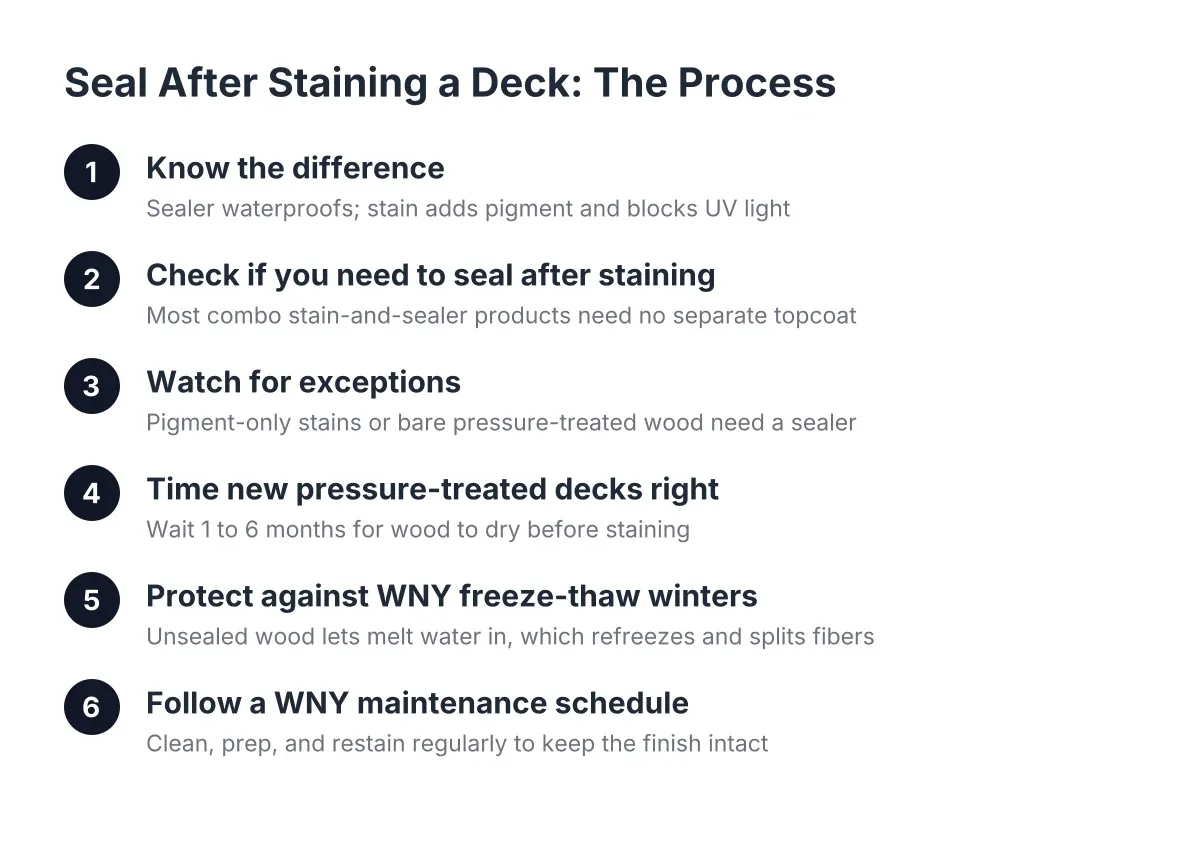
If you used a combination stain-and-sealer product, you do not need a separate seal coat on top, and in most cases you should not add one. The stain already carries the waterproofing. Layering a clear sealer over it can trap moisture, cause peeling, and create a slippery film, which is the last thing you want on a pool deck. When deciding whether you should seal after staining your deck, understand that most modern stains already include sealing protection.
There are two exceptions worth knowing.
First, if you applied a pigment-only or oil-based penetrating stain that explicitly says it contains no sealer, then yes, you need a waterproofing topcoat. These products are less common now, but they exist, especially in specialty wood finishes. Check the can. If it does not say "seals" or "waterproofs," assume it does not.
Second, bare pressure-treated wood with no finish at all needs something before its first Buffalo winter. The treatment chemicals in pressure-treated lumber resist rot and insects. They do not resist water absorption. Untreated-surface boards soak up fall rain, freeze in December, and start checking and cupping by March. So if the question is "do you need seal protection on a brand new pressure-treated deck," the answer is yes, after the wood dries out.
Why Adding Sealer Over Stain Usually Backfires
Film-forming sealers over a solid stain create a plastic-like layer that cannot flex with the wood. Western New York decks move. Boards expand in humid July weather and contract hard in January cold. A rigid double layer cracks, water slips under the crack, and the whole finish peels in sheets. Then you are stripping the deck down to bare wood before you can refinish it, which adds labor and cost.
On pool decks, a glossy sealer over stain also kills traction. Wet feet on a slick film is a safety problem, not a cosmetic one. If your deck surrounds an above ground pool, stick with a penetrating stain-and-sealer and skip any topcoat that dries to a shine.
When to Seal After Staining a Pressure-Treated Deck
A new pressure-treated deck in Buffalo needs its first stain-and-sealer coat after the wood has dried, typically 1 to 6 months after construction depending on the lumber and the season. Finish it too early and the product cannot penetrate wet wood. Wait too long and UV damage and water absorption start before the wood is protected.
Pressure-treated lumber arrives from the yard saturated with treatment solution. You can often feel the dampness. Stain applied to wet boards sits on the surface, dries blotchy, and peels within a year.
The simple test: pour a few drops of water on a board. If the water soaks in within a minute or two, the wood is ready to accept stain. If it beads up, wait a few more weeks and test again.
Timing matters in our climate. Suppose a homeowner in Cheektowaga gets an above ground pool deck built in late July. The boards probably will not pass the water test until late September or October. That is fine. Staining a new pressure treated deck in fall works as long as you get two or three dry days with temperatures above about 50 degrees. If the weather window closes before the wood is ready, let the deck go through winter bare and stain it in late spring. One unprotected winter on new lumber is not ideal, but it beats a failed finish you have to strip off.
What WNY Winters Do to an Unsealed Deck
Freeze-thaw is the whole story here. Buffalo winters do not just get cold; they cycle. A February week can swing from 15 degrees to 40 and back. Every thaw sends melt water into unprotected wood. Every refreeze expands that water about 9 percent and wedges the wood fibers apart.
On an unsealed or failed-finish deck, the damage follows a pattern we see on repair calls every spring:
- Surface checking: small cracks along the grain that widen each winter and collect more water.
- Cupping: boards curl at the edges as the top and bottom dry at different rates, creating puddles that feed the cycle.
- Fastener pops: moving wood pushes screws and nails up, which opens entry points at every fastener hole.
- End-grain rot: board ends soak up water fastest, so rot usually starts at butt joints and stair treads.
- Ledger and framing rot: the expensive one, where water works past failed deck boards into the structure underneath.
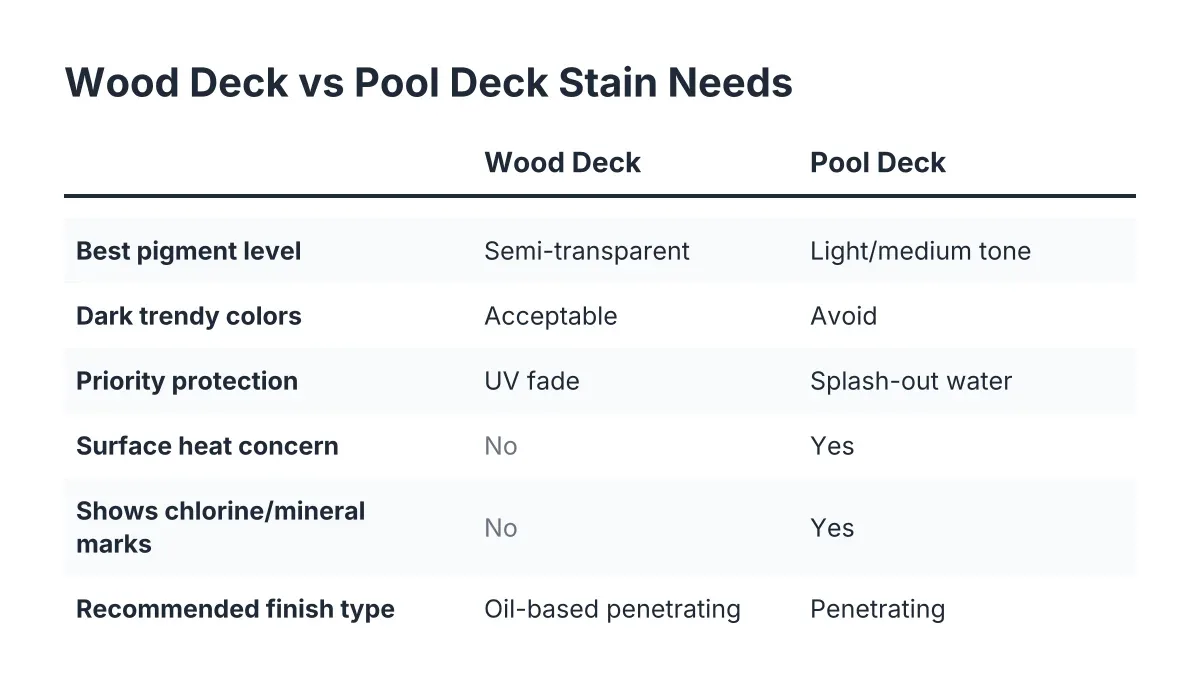
Pool decks take extra punishment. Splash-out from an above ground pool keeps nearby boards wet all summer, and chlorinated or salt-system water is harder on finishes than rain. Then the pool gets closed, the splash zone never fully dries, and winter locks that moisture in. If your old pool deck is rotting mostly in the three feet closest to the pool wall, that is why.
Snow load adds its own pressure. Lake-effect snow can sit on a deck for months, pressing melt water into the surface the entire time. Shoveling the deck after big storms helps the finish last, and it reduces stress on the framing.
How Often to Stain a Deck in Buffalo
Plan on restaining a Buffalo wood deck every 2 to 3 years for semi-transparent stain and every 3 to 5 years for solid stain. Those intervals run shorter than the 4 to 6 years a can might promise, because the label was not written for a climate with lake-effect snow and 40-degree February swings.
Sun exposure changes the number. A south-facing deck with no shade burns through finish faster than a shaded north-side porch. High-traffic paths and stair treads wear first. Pool deck splash zones fail fastest of all. You can spot-recoat worn areas in between full restains, which stretches the overall schedule.
The water-bead test tells you when the finish is done, not the calendar. Sprinkle water across several boards in spring. Where it beads, the seal is working. Where it soaks in flat within a couple of minutes, the protection is gone and that area needs attention before the next winter, not after it.
A Deck Maintenance Schedule Built for WNY
Here is the year-round routine we would give any Buffalo homeowner with a wood deck, pool deck or not:
- Spring (April to May): Sweep off winter debris, inspect for popped fasteners and soft spots, and run the water-bead test. If the finish failed, plan to clean and restain in early summer.
- Early summer (June): Wash the deck with a deck cleaner and a garden hose or low-pressure wash. Restain if the spring test said so. Give the wood 2 to 3 dry days before applying anything.
- Through pool season: Rinse pool splash zones with fresh water every few weeks. It dilutes the chemical residue that degrades finish.
- Fall (October): Clear leaves off the deck completely before snow. Wet leaves sitting under snow are a rot accelerator. A fall deck cleaning before winter is the cheapest protection you can buy.
- Winter: Shovel after heavy lake-effect storms with a plastic shovel, and skip rock salt, which damages both wood finish and fasteners. Use sand for traction instead.
None of this is complicated. The homeowners who follow a routine like this get a decade or more out of a pressure-treated deck surface. The ones who skip it are the spring repair calls.
Cleaning and Prep: Where Most DIY Staining Goes Wrong
Stain fails early far more often because of bad prep than bad product. New stain over dirt, mildew, or old failing finish peels no matter how good the can is.
The prep sequence that works:
- Clear the deck completely, including planters and pool ladders.
- Apply a deck cleaner or brightener to kill mildew and open the wood pores.
- Rinse with a garden hose or a pressure washer on a low setting with a wide fan tip, held well off the wood. High pressure up close gouges soft spring-growth grain and leaves fuzzy, splintered boards.
- Let the deck dry 2 to 3 days of real dry weather, not just one sunny afternoon after a rainy week.
- Sand any fuzzy or splintered spots, and sand glossy old finish so new stain can grip.
If you hire out the wash, deck power washing cost varies with deck size, height, and how much old finish has to come off; a basic rinse on a small patio deck is a different job than stripping a failed solid stain off a two-level deck. The same goes for full deck staining services. Decks with lots of railing, built-in benches, or pool-side framing take more brush time than open floor area, and the quote should reflect that honestly.
One trade-off worth stating plainly: a professionally prepped and stained deck costs more upfront than a weekend DIY job, and a careful homeowner can absolutely do this work well. Where it pays to bring in help is a deck that already shows soft boards, rot at the ledger, or framing movement. At that point you are past finish maintenance and into deck repair, and staining over structural problems just hides them for one more winter.
Choosing the Best Deck Stain and Sealer for a Cold Climate
For Buffalo conditions, the best deck stain and sealer is a penetrating semi-transparent or semi-solid product rated for freeze-thaw climates, with real pigment for UV protection. Penetrating products soak into the wood and flex with it. Film-forming products sit on top and eventually crack in our temperature swings.
A few selection rules that hold up in WNY:
- More pigment means more UV protection and longer life, but less visible wood grain. Solid stain lasts longest; clear sealer alone lasts one season here at best.
- For pool decks, choose a product labeled slip-resistant or at minimum one that dries flat, not glossy.
- Oil-based penetrating stains go deeper into dense pressure-treated lumber; modern water-based formulas clean up easier and hold color well. Both can work. What fails here is anything that forms a hard shell.
- Buy enough to do the whole deck from the same batch so the color matches.
This is also the honest moment to mention composite. A big share of the pool decks we build in Western New York now are composite deck builds, precisely because splash zones destroy wood finish on a schedule. Composite decking never needs deck staining and sealing, shrugs off pool chemicals, and handles freeze-thaw without checking. It costs more upfront than pressure-treated wood. Over 15 years of skipped restaining, the math narrows. If you are retrofitting a deck around an above ground pool in 2026 and comparing materials, run that comparison before defaulting to wood.
Pool Decks Need More Than a Good Finish
Finish care protects the surface, but an above ground pool deck lives or dies on how it was built. If you are planning one, or replacing a rotted one, three structural points matter as much as any stain choice.
First, the deck height has to match the pool rail, usually sitting flush with or just under the top rail, so there is no trip edge at the water. Framing around a round pool takes angled blocking and careful layout, not a rectangle with a hole cut in it.
Second, footings matter. Erie County frost depth means footings dug to 42 inches, below the frost line, so the deck does not heave while the pool stays put. A deck on surface blocks next to a 20,000-pound pool will move independently of it every winter.
Third, permits. A pool deck is a real structure, not a pool accessory, and most WNY towns treat it that way. New York's residential code requires 36-inch guard rails once the walking surface is more than 30 inches above grade, according to Mister Baluster, and nearly every above ground pool deck crosses that line. Your town's building department will want footing depth, framing, and railing details. Skipping the permit risks problems at inspection or resale.
The Bottom Line for Buffalo Decks
Do you need seal over stain? No, not if your stain contains a sealer, and nearly all of them do now. What you need is the right penetrating stain-and-sealer applied to clean, dry wood, on a 2 to 3 year cycle, with a real fall cleaning before the snow flies. That routine is the difference between a pool deck that lasts 15 years and one that becomes a spring repair call.
The finish is maintenance. The structure is forever, or close to it. Get the footings, framing, height, and permit right when the deck goes in, keep the finish honest every couple of years, and a wood deck can handle everything a Western New York winter throws at it. Skip either half of that equation and the winter wins.
If you need deck building, WNY Deck Builders can help.
Prefer to talk it through? Call (716) 317-4901 — a quick call is usually the fastest way to get a straight answer for your situation.