Repair or Replace? How to Tell Before You Restore a Deck in Buffalo
A soft board here, a wobbly railing there, and now you are wondering whether the whole deck is done. Before you decide to restore a deck or tear it out, you need an honest read on what is actually failing. Most deck problems in Buffalo fall into two buckets: surface wear you can fix, and structural damage you cannot patch over. This guide walks you through checking your own deck, step by step, so you know which bucket you are in before anyone quotes you a full replacement.
That distinction matters even more if your deck wraps an above ground pool. Splash-out, pool chemicals, and constant wet-dry cycles age a pool deck faster than a regular patio deck. Add Western New York freeze-thaw on top of that, and a ten-year-old pool deck can look twenty. The steps below apply to any deck, with extra notes where pool decks fail differently.
Step 1: Probe the Boards Before You Judge by Looks
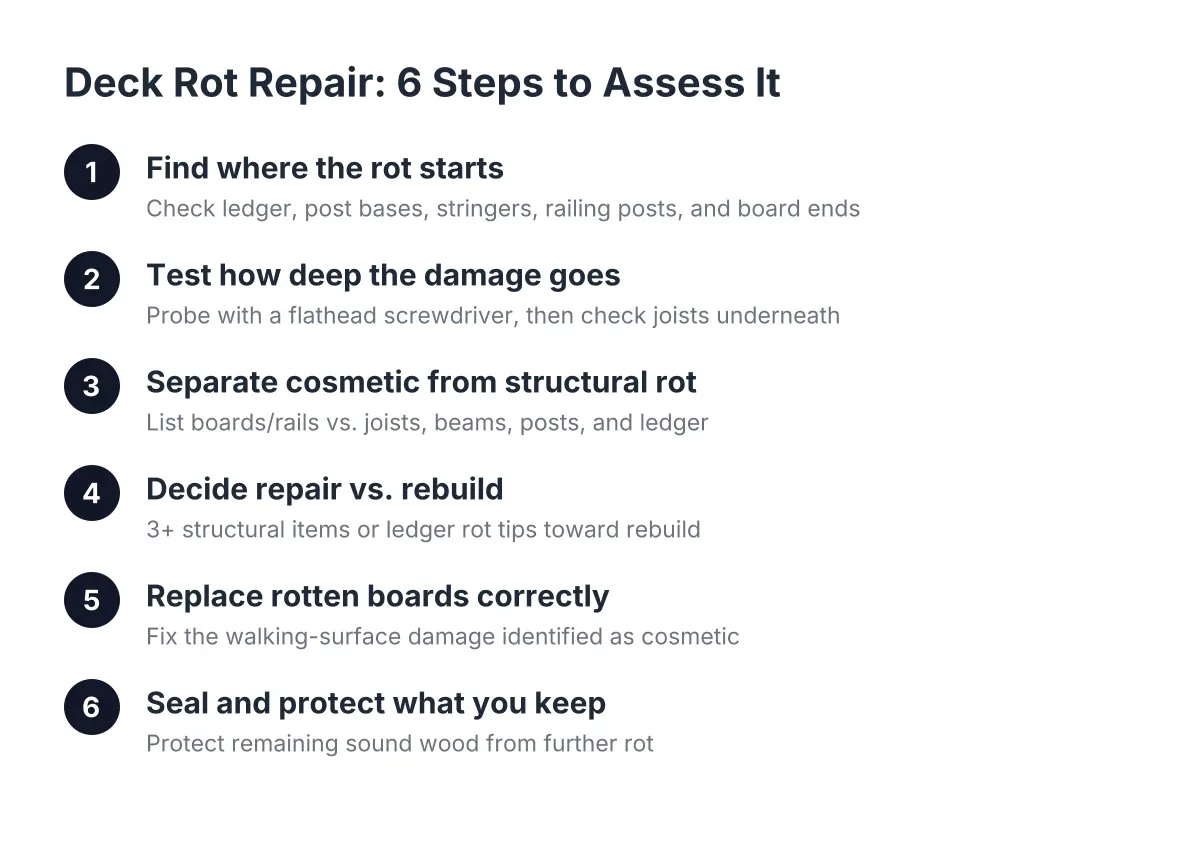
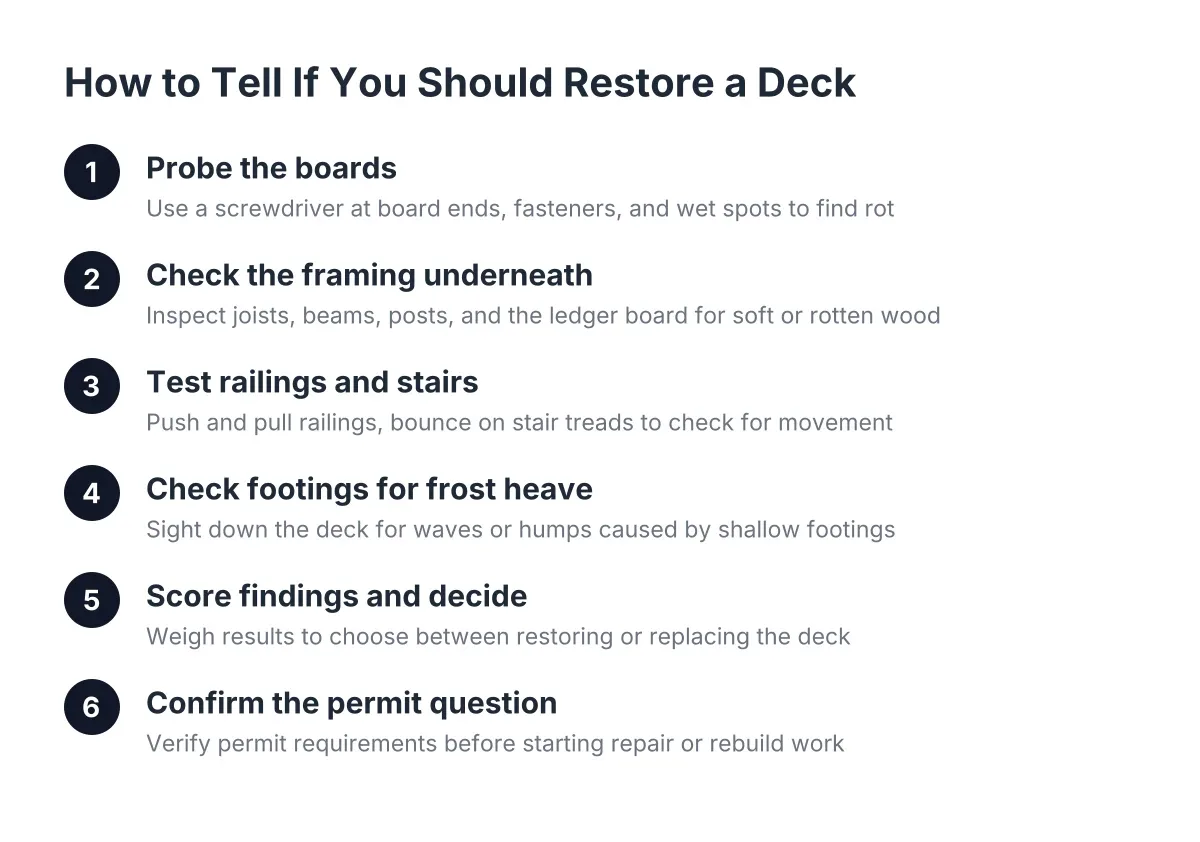
Start with a screwdriver, not your eyes. Gray, weathered boards often look worse than they are, and a stained board can hide rot underneath. Push the tip of a flathead screwdriver into the wood at board ends, around fasteners, and anywhere water pools.
Solid wood resists the tip. Rotten wood lets it sink in with light pressure, sometimes half an inch or more. Mark every soft spot with chalk or painter's tape as you go.
Pay special attention to these areas:
- Board ends near the pool wall, where splash-out soaks in daily
- The stair stringers and bottom step, which stay damp longest
- Boards under planters, mats, or the pool ladder
- Any spot where the deck meets the house, especially at the ledger board
- Fastener holes, since screws give water a path into the board
A few soft deck boards do not condemn a deck. Rotten deck boards repair is one of the most common jobs a deck builder handles, and swapping a handful of boards costs a fraction of a rebuild. However, if more than a quarter of the boards fail the screwdriver test, keep reading before you spend money on decking.
Step 2: Get Under the Deck and Check the Framing
The decking is the skin. The framing is the skeleton, and it decides whether you repair or replace. Crawl under the deck with a flashlight and repeat the screwdriver test on the joists, beams, and posts.
Look for these warning signs:
- Soft or crumbling wood at the top edge of joists, where boards trap water against them
- Dark staining or fungus along beam faces
- Joists that have pulled away from their hangers, or hangers that are rusted through
- Posts that are soft at ground level or sitting directly on soil
- A ledger board with rot or missing flashing where the deck attaches to the house
Here is the honest line most homeowners never hear: you can replace every deck board and still have an unsafe deck. If the joists are punky or the ledger is rotting, new decking just hides the problem for a few seasons. On the other hand, if the framing is sound and only the surface is tired, a full deck replacement is money wasted. Solid framing under worn boards is the single best case for choosing to restore a deck instead of rebuilding it.
Step 3: Test the Railings and Stairs Like a Kid Would
Grab the top of each railing post and push hard, then pull. A railing that moves more than an inch at the top is a fall waiting to happen, and around a pool it is the most urgent fix on the list. Wet feet, running kids, and a loose deck railing do not mix.
Check the stairs next. Stand on the edge of each tread and shift your weight. Bounce, tilt, or visible gaps between the stringer and treads mean the connections are failing. Railing and stair fixes usually count as repair work, not replacement; the exception is when the posts wobble because the framing they bolt to has rotted.
Step 4: Check the Footings for Frost Heave
Buffalo winters move decks. When footings sit shallower than the local frost depth, which runs 42 inches in most of Erie County, freeze-thaw cycles push them up and drop them back down. Over the years, that heaving twists framing, opens gaps, and cracks connections.
Sight down the deck surface from one end. Waves, humps, or a corner that sits higher than the rest usually trace back to heaved footings. For a pool deck, heave is a bigger deal because the deck height has to match the pool wall. A deck that heaves an inch next to a pool that does not creates a trip edge right where people climb out with wet feet.
You cannot repair a heaved footing from above. Fixing it means excavating and pouring a new footing below frost depth, which is closer to partial rebuild than repair. If two or more footings have heaved, get a professional deck inspection before you spend anything on the surface; this is one call worth making rather than guessing.
Step 5: Score What You Found, Then Decide
Now put it together. As a rule of thumb for 2026, here is how the findings sort out.
How to Restore Decking Wisely
Restoring a deck makes sense when the framing, footings, and ledger all pass inspection and the damage is limited to the walking surface, railings, or a handful of boards. In that case, board replacement, new railing hardware, cleaning, and refinishing can add years of life for far less than a rebuild.
The restoration path typically includes replacing marked boards, tightening or replacing loose fasteners, then washing the deck with a deck cleaner and brightener before applying a fresh stain. On a wood pool deck, a solid stain holds up better against chlorinated splash-out than a clear sealer, though it will still need recoating every few seasons. That maintenance cycle is the trade-off of keeping wood around a pool.
When Replacement Is the Honest Answer
Replace the deck when the skeleton is failing. Rotten joists, a compromised ledger, heaved or undersized footings, or framing that was never built for our snow loads all point the same way. Patching a bad frame is how decks end up in the news.
For pool decks specifically, replacement is often the smarter call when the old deck no longer matches the pool. Say a homeowner in Cheektowaga replaces a 48-inch pool with a 54-inch model. In that scenario, the old deck sits six inches low, and reframing an existing structure to a new height usually costs more than framing fresh. A rebuild also opens the door to composite deck boards, which shrug off pool chemicals and skip the staining cycle entirely.
On cost, national figures give you a rough anchor. Professional deck labor typically runs $15 to $35 per square foot, and a professionally built new deck averages $30 to $60 per square foot, according to NerdWallet citing Angi. Your actual number depends on size, material, railing, and site conditions, so treat those as orientation, not a quote. There is a consolation on the replacement side too: homeowners recover 89% of the cost of a new wood deck at resale, according to NerdWallet citing the National Association of Realtors' 2023 Remodeling Impact Report.
Step 6: Confirm the Permit Question Before Work Starts
Do not assume a pool deck skips the permit process because it is "just around a pool." In most Erie County towns, a deck attached to the house, elevated above grade, or serving as pool access needs a permit, and pool barriers carry their own code requirements for railing height and gate hardware. An unpermitted deck can also stall a home sale later.
A deck builder who handles permits and code compliance planning as part of the job will sort this town by town. If you are getting quotes, ask each contractor directly who pulls the permit. The answer tells you whether they treat your pool deck as a real structural project or an afterthought bolted to a pool.
What an Honest Assessment Looks Like
A fair deck repair and restoration assessment starts underneath, at the framing and footings, not on top where the cosmetic problems live. If a contractor quotes a full replacement without crawling under the deck, or quotes a restoration without checking the ledger, keep looking. The right answer for your deck is whichever one the structure supports, and in Buffalo, the structure includes footings below frost depth and framing sized for lake-effect snow.
Run the screwdriver test, check the frame, and score what you find. You will walk into every contractor conversation knowing whether you are shopping for a repair or a rebuild, and that knowledge is worth more than any sales pitch.
If you need deck building, WNY Deck Builders can help.
Prefer to talk it through? Call (716) 317-4901 — a quick call is usually the fastest way to get a straight answer for your situation.