Deck Builder Credentials: Licensing, Insurance, and Bonding in Western New York
You have three quotes sitting on the kitchen table. One is from a guy with a truck and a Facebook page. One is from a general contractor who also does kitchens, roofs, and bathrooms. Additionally, one is from a company that only builds decks. Before you sign anything, you need a way to conduct a deck builder credentials check—licensing, and insurance—because in Western New York those three things separate a deck that lasts from a deck you tear out in five years.
This matters double if you are replacing a rotting deck or putting a deck around a new above ground pool. A failing deck usually failed because someone skipped a step the first time. A pool deck has safety rules a casual builder may not know. Here are the questions homeowners ask most, with straight answers.
Does a Deck Builder Need a License in Buffalo, NY?
New York State does not issue a statewide contractor license, so deck builder license requirements in Buffalo depend on the city or town where you live. Buffalo and many Erie County towns require contractors to register or hold a local home improvement license before pulling permits. Ask the builder which towns they are registered in and verify it with your town's building department.
This is the part that surprises people. A builder can be completely legal in one town and unregistered in the town next door. If your builder cannot pull a permit in your town under their own name, that is your answer about their standing there.
What Should You Check Before Signing? Deck Builder Credentials and Licensing
Before signing a deck contract, verify four things: local licensing or registration in your town, general liability insurance, workers' compensation coverage, and the builder's name on the permit. Ask for certificates of insurance sent directly from the insurance company, not a photocopy from the builder. A legitimate deck builder expects these questions and answers them without friction.
Here is the short checklist to run on every quote:
- Local license or registration in your specific Buffalo-area town, verified with the building department
- General liability insurance that covers damage to your home during construction
- Workers' compensation, so an injured worker does not become your homeowner's insurance claim
- Permit pulled under the builder's name, not yours
- A written contract with scope, materials, payment schedule, and what happens if hidden rot turns up
If any one of these is missing, the low price on that quote is not actually low. You are just holding the risk yourself.
Why Does Insurance Matter More Than the Quote Price?
Insurance matters because deck construction involves digging footings near your foundation, framing heavy structures, and workers on ladders. Without liability coverage, damage to your siding, gas line, or septic field comes out of the builder's pocket, which often means it comes out of nobody's pocket. Without workers' comp, an injury on your property can land on you.
Suppose a homeowner in Cheektowaga hires the cheapest quote to replace a rotting deck. The crew hits a buried downspout line while digging footings, floods a corner of the basement, and the builder has no liability policy. In that scenario, the homeowner saved maybe fifteen percent on the bid and now owns a water damage repair. Insurance is the credential that protects you, not the builder.
What Is the Difference Between a Deck Contractor and a General Contractor?
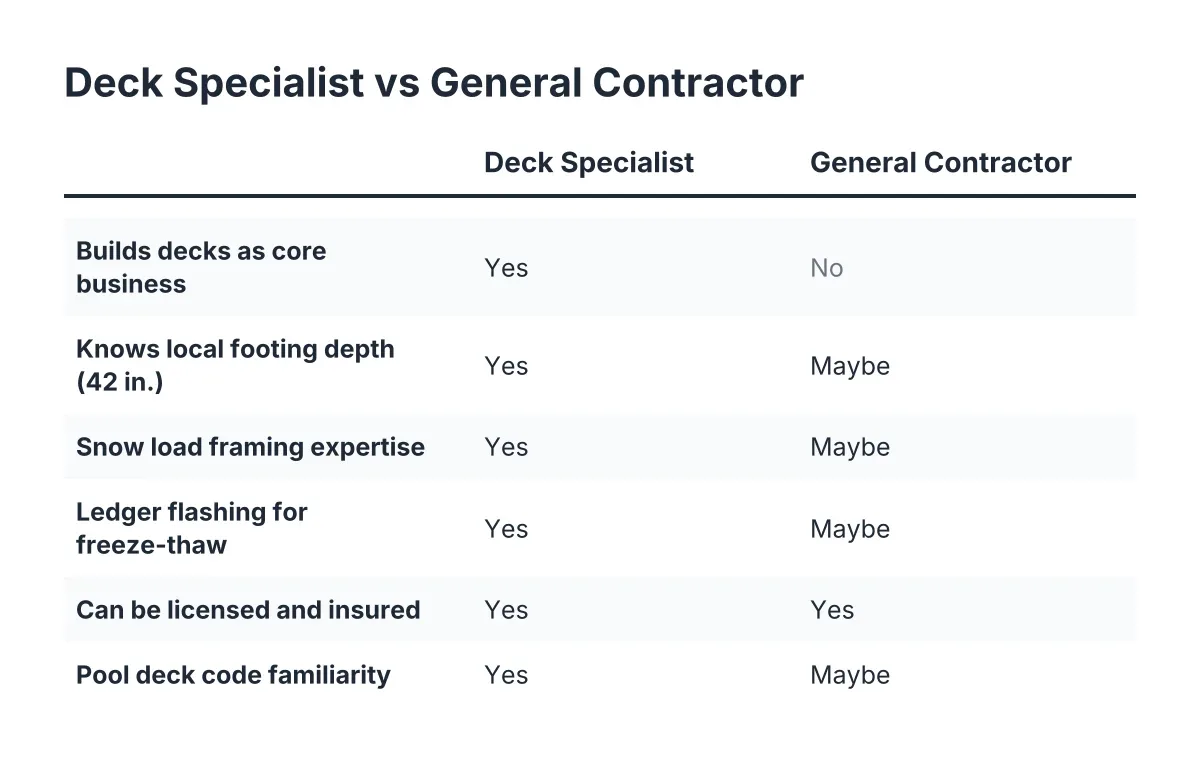
A deck contractor builds decks as the whole business; a general contractor builds decks as one line on a long services list. Both can be licensed and insured, so credentials alone will not tell them apart. The difference shows up in the details: footing depth, snow load framing, flashing at the ledger, and drainage planning.
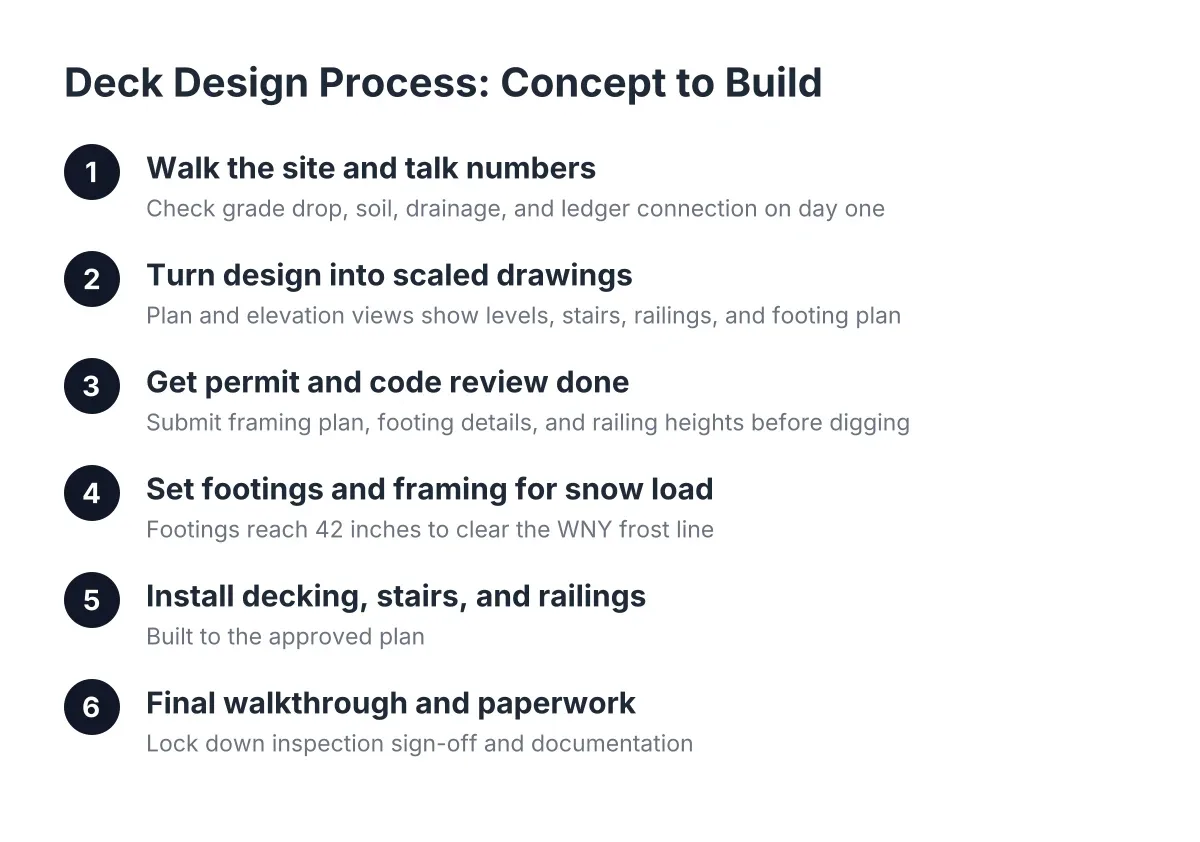
In Western New York, those details are not optional. Frost here requires footings dug to 42 inches, and lake-effect snow means the framing has to carry real snow load, not a Sun Belt span table. A specialist deals with freeze-thaw movement on every job. A generalist may build a deck that looks fine in July and heaves by March.
What Questions Should I Ask a Deck Builder Before Hiring?
The best questions to ask a deck builder are specific and local: How deep do you dig footings here? Who pulls the permit? How do you flash the ledger against our freeze-thaw cycles? What decking do you recommend for a pool deck, and why? When you ask a deck builder these questions and assess their credentials and background, vague answers to specific questions are the clearest red flag you will get.
Add these to the conversation:
- Can I see a deck you built three or more winters ago, not three months ago?
- What does your warranty cover, labor and structure, or just the manufacturer's material warranty on composite decking like Trex decking material?
- How do you handle hidden rot or bad framing you find after demo starts?
- What is the payment schedule, and how much is due before work begins?
A deck building warranty on labor is where specialists and generalists separate fast. Composite boards carry long manufacturer warranties, but the manufacturer does not cover footings that heave or a ledger that pulls away from the house.
Red Flags for a Deck Builder Credentials Check
The biggest red flags when hiring a deck contractor are a request to skip the permit, a demand for most of the money up front, no written contract, and no verifiable insurance. Each one shifts risk from the builder to you. Any one of them is reason enough to walk.
"We can skip the permit and save you money" deserves special attention. Unpermitted work can block a home sale, void insurance claims, and trigger fines. For scale, according to PermitsGuide, penalties for unpermitted deck work in New York City run from $2,500 to $25,000, with daily penalties until resolved. Buffalo-area fines differ, but the lesson travels: the permit protects you, and a builder who dodges it is dodging inspection of their own work.
Do Pool Decks Have Extra Code Requirements?
Yes, pool decks carry extra requirements beyond a standard patio deck, mainly around guard height, gate access, and climb resistance. According to Mister Baluster, New York's residential code requires a 36-inch guard once the walking surface sits more than 30 inches above grade, which covers nearly every above ground pool deck. Ask your builder to walk you through the code plan before they quote.
If a builder quoting your above ground pool deck cannot explain the deck railing and entry rules without looking them up, they have not built many pool decks. That is worth knowing before summer, not after the inspection fails.
How Do I Know If My Rotting Deck Needs Repair or Full Replacement?
Soft boards alone often mean deck repair; soft framing, rotted posts, or a ledger pulling from the house usually mean replacement. Decking boards are the skin, and framing is the skeleton. A wobbly deck railing can be a simple fix or a symptom of rotten rim joists underneath, and only someone looking under the deck can tell you which.
This is exactly where credentials connect to honesty. A licensed, insured builder who pulls permits has to put their name on the fix, so they have a reason to diagnose it correctly. An uninsured patch job carries no accountability, which is how a repair fails again the next spring. Before you decide to repair or replace, use a professional deck builder credentials check—examining their licensing, insurance, and permit history—to verify who you're trusting with the assessment; that is not a judgment call to make from the kitchen window.
How Do Credentials Affect What a Deck Costs?
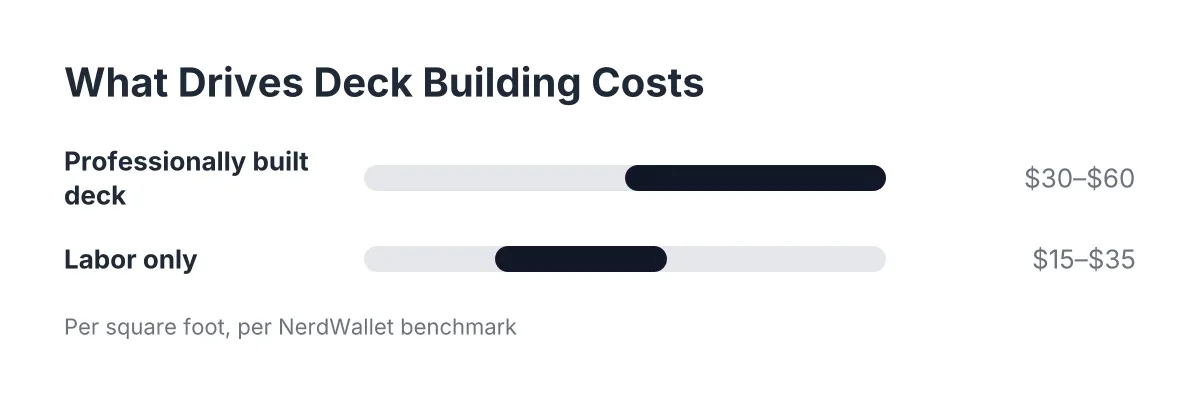
Licensed and insured builders cost more than uninsured ones because registration, insurance premiums, permits, and code-compliant footings are real expenses built into the quote. For context, NerdWallet reports that a professionally built deck averages $30 to $60 per square foot according to Angi, with labor typically $15 to $35 of that. A free deck calculator online can rough out materials, but it will not price 42-inch footings, snow load framing, or your town's permit path.
As a result, the gap between quotes often is not profit margin. It is the cost of doing the job legally and to code versus not. When you compare deck builder credentials, licensing status, and insurance across your three quotes, you are really comparing who holds the risk. The cheapest bid usually hands that risk to you.
The Bottom Line for Buffalo Homeowners
Checking credentials takes two phone calls: one to your town building department, one to the builder's insurance agent. That half hour of work filters out most of the contractors who would patch your rotting deck badly or build a pool deck that fails inspection. In a region where frost, snow load, and freeze-thaw punish shortcuts, the paperwork is not bureaucracy. It is the first piece of evidence about how the builder handles everything else.
If you need deck building, WNY Deck Builders can help.
Related guide: hiring a deck builder — Complete Guide
Prefer to talk it through? Call (716) 317-4901 — a quick call is usually the fastest way to get a straight answer for your situation.