Deck Cost Per Square Foot in Buffalo: Labor, Materials, and Permits Explained
If you have collected two or three deck quotes in Buffalo, you have probably noticed the numbers do not line up. One builder quotes a figure that sounds reasonable, another comes in thousands higher for what looks like the same deck. The gap almost always comes down to how each builder calculates the deck cost per foot and what each one includes in that number. This guide breaks down the real cost drivers, factor by factor, so you can read a quote the way a builder does instead of guessing from a national calculator.
One thing up front: you will not find made-up dollar figures here pretending to be your price. A deck in Amherst with 42-inch frost footings and a snow-load-rated frame does not price like a deck in Georgia, and any article that hands you one tidy number is skipping the parts that actually move your total. What we can do is show you every lever that moves the price, and where verified national data gives you a sanity check.
What Deck Cost Per Square Foot Actually Measures
Deck cost per square foot is the total project price divided by the deck's surface area, and it bundles everything together: labor, framing, footings, decking boards, railing, stairs, hardware, and permits. That is why the number swings so widely between quotes. Two builders can quote the same square footage and mean completely different projects.
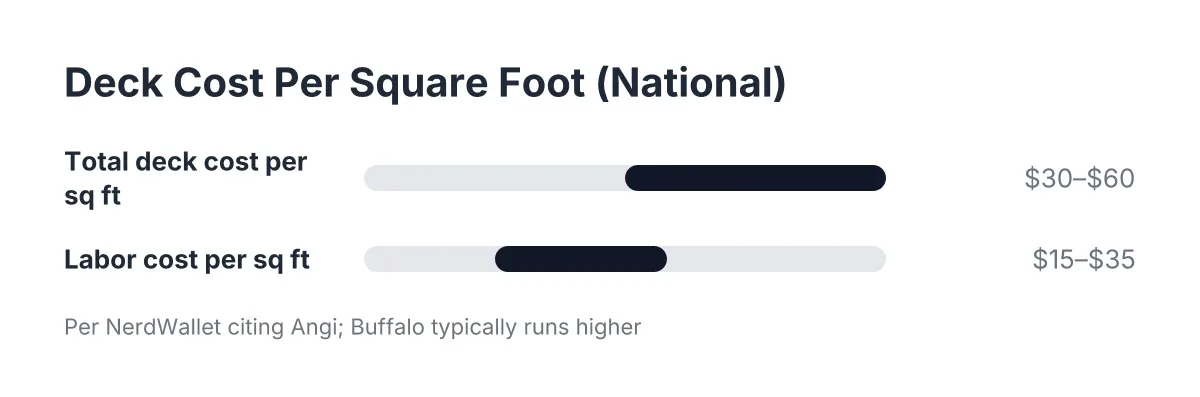
For a national reference point, the average cost to add a professionally built deck runs between $30 and $60 per square foot, according to NerdWallet citing Angi. Labor alone typically runs $15 to $35 per square foot by the same source. Notice that labor can be half the total or more. That matters in Western New York, where the labor-heavy parts of the job, footings and framing, are bigger than they are in mild climates.
However, the per-square-foot number hides something important: it is not linear. A 120 square foot deck does not cost half of what a 240 square foot deck costs. Permits, mobilization, design time, and stair construction are roughly fixed whether the deck is small or large. As a result, small decks almost always carry a higher cost per square foot, and larger decks look cheaper per foot even though the total is higher.
Keep that in mind when you compare your quotes against a trex decking cost calculator or any online deck calculator. Cost tools average across thousands of projects in every climate. They do not know your yard slopes toward the pool, that your soil is heavy clay, or that your town wants engineered drawings for anything attached to the house.
Why Buffalo Decks Cost More Per Square Foot Than the National Average
Buffalo deck construction costs more per square foot than the national average because Western New York weather forces deeper footings, heavier framing, and materials that survive freeze-thaw cycling. The structure under the deck is built to a harder standard here, and most of that extra cost sits below the deck boards where you never see it.
Three local realities drive this:
- 42-inch frost-depth footings. Erie County frost depth means footings go down 42 inches, not the 12 to 24 inches common in warmer states. Deeper holes mean more digging, more concrete, and more labor per post. Skip this and freeze-thaw heave will lift your deck unevenly within a few winters.
- Snow-load framing. Lake-effect snow puts real weight on a deck. Framing sized for Buffalo snow load uses closer joist spacing, larger beams, or both. That is more lumber and more labor than a sunbelt deck of the same footprint.
- Freeze-thaw-rated materials. Decking, fasteners, and flashing all have to handle water that freezes and expands dozens of times a season. Composite and PVC boards that hold up to that cycling cost more upfront than builder-grade pressure-treated pine.
Therefore, when a quote from a Buffalo deck builder comes in above what a national deck calculator cost tool predicted, the gap is usually the structure, not padding. A builder who quotes you a sunbelt price for a WNY deck is either planning to under-build the frame or planning a change order later. Neither is a bargain.
The Five Cost Drivers Behind Every Quote
Every deck quote in Western New York comes down to five factors: size and shape, decking material, footings and framing, railings and stairs, and permits. Understand these five and you can decode any quote, spot what is missing, and ask the right questions before you sign.
Size and shape
Square footage sets the baseline, but shape moves the number more than most homeowners expect. A simple rectangle is the cheapest shape to frame and deck. Every angle, curve, or level change adds cutting time, wasted board material, and extra framing.
For example, an octagonal section wrapping an above ground pool takes meaningfully more labor per square foot than a straight rectangle of the same area. The crew is making angled cuts on every board instead of running full lengths. This is one reason pool decks often surprise homeowners who priced the project off a rectangular deck calculator.
Height matters too. A deck 24 inches off the ground is a straightforward build. A deck at 52 inches to match an above ground pool wall, or an elevated deck off a second-story door, needs taller posts, more bracing, longer stairs, and railing everywhere. Multi level deck cost runs higher per square foot than single-level for the same reason: each level is its own small framing project with its own connections.
Decking material: wood vs composite deck cost
Material choice is the cost lever you control most directly. Pressure-treated lumber is the cheapest option upfront. Composite costs more per board, and PVC sits above composite. The spread between a wood deck and a premium composite deck on the same frame can be substantial, often the single biggest line-item difference between two quotes.
That said, the upfront number is only half the comparison. Wood in Buffalo needs cleaning, staining, and sealing on a regular cycle, and even well-maintained wood takes a beating from freeze-thaw cycles. Around a pool, add splash-out and pool chemicals to the list, and wood's maintenance math gets worse. Composite costs more on day one and then mostly asks to be hosed off.
If you are pricing composite, be careful with tools like a trex decking cost calculator. Trex decking cost per square foot varies by product line, and the entry line and the premium line are different budgets entirely. A calculator that does not ask which line you want is averaging across all of them. Get your builder to name the specific product and line in the quote so you can compare quotes on equal footing.
Footings and framing: the cost you cannot see
The cost of deck footings and framing is the least visible part of your quote and the least negotiable. In Erie County, footings go to 42-inch frost depth. Count the posts on your plan and multiply: each one is a dug hole, a concrete pour, and an inspection point. Decks with more levels, more height, or heavy hot-tub loads need more footings, and the footing line grows accordingly.
Framing follows the same logic. Snow load drives joist size and spacing, beam size, and the hardware that ties it all together. Attached decks also need proper ledger flashing so meltwater cannot sit against your house framing. Drainage planning around the footings matters too; water pooling around a post base is how frost heave starts.
Here is the practical takeaway: if one quote is far cheaper than the others, ask specifically about footing depth, joist spacing, and ledger flashing. The savings often live in the structure, where you will not see the shortcut until a few winters from now.
Railings and stairs
Deck railing cost surprises people because railing is priced by the linear foot, separate from the deck surface. A low platform deck might need no railing at all. An elevated deck or a pool deck needs railing on every open edge, and code requires it above certain heights. Material drives the range: pressure-treated wood railing is the budget option, composite railing costs more, and aluminum or cable systems sit at the top.
Stairs are their own line item. Each stair is a small framing project with stringers, treads, and often a railing on both sides. A tall deck with a long staircase can carry a stair cost that rivals a chunk of the deck itself. On pool decks, stairs plus a gate are also a safety requirement, not an option.
Permits and code compliance
Permit cost for a deck in Western New York depends on your town; Buffalo, Amherst, Cheektowaga, and the other Erie County towns each run their own permit office with their own fee schedule. The fee itself is usually a small fraction of the project. The real value is the inspection record proving your footings and framing meet code, which matters when you sell the house.
For scale on how fee formulas work elsewhere, New York City calculates deck permit fees at $100 for the first $5,000 of work plus $13 for every additional $1,000, according to PermitsGuide. WNY towns use their own schedules, but the structure is similar: fees scale with project value, and they are modest next to the cost of skipping them. PermitsGuide also notes that NYC penalties for unpermitted deck work run $2,500 to $25,000 with daily penalties until resolved. Your town's fines will differ, but unpermitted work anywhere can stall a home sale or force a tear-out.
In addition, a good builder handles permits and code compliance planning as part of the job. If a quote says nothing about permits, ask who is pulling them. "The homeowner handles permits" is a yellow flag on a structural project.
How Pool Decks Change the Cost Per Square Foot Math
An above ground pool deck costs more per square foot than a standard patio deck of the same size because it is a height-matched, safety-regulated structure built in a wet, chemical-exposed environment. It is a real structural job, not an add-on, and the quote should read like one.
Suppose a homeowner in Cheektowaga just had a 24-foot round pool installed with a 52-inch wall. The deck has to land flush with the pool rail, which means every post height is custom and the framing wraps a curve. The surface needs to be safe to walk on wet, so board choice and spacing matter more than on a dry patio deck. Splash-out and pool chemicals rule out bargain materials that would rot or corrode in a few seasons. Then code adds a self-closing gate and railing requirements, because a deck attached to a pool is pool access.
In that scenario, the pool deck's cost per square foot lands well above what the same homeowner would pay for a simple rectangular deck off the back door. None of that is upcharging; every added dollar maps to a physical difference in the build. If a builder quotes your pool deck like a basic platform, that is the afterthought treatment you were worried about, and it is worth getting a second quote from someone who builds pool decks as a core job.
One more pool-specific note: yes, it almost certainly needs a permit. Towns treat decks attached to pools as structures with safety code attached, even when freestanding. Confirm with your town's building department before anyone digs.
Reading Your Quotes: A Line-by-Line Comparison Checklist
Now put the cost drivers to work. When your two or three quotes come in, compare them line by line rather than bottom line against bottom line. A cheaper total with a thinner scope is not a better price; it is a smaller project wearing the same name.
Walk through this checklist with each quote:
- Footing depth and count. Does it state 42-inch frost-depth footings and say how many? A quote that skips footing detail is skipping the part Buffalo weather punishes hardest.
- Framing spec. Joist size and spacing, beam size, and hardware. Snow-load framing should be stated, not assumed.
- Exact decking product. Brand, line, and color, not just "composite." This is where a thousand-dollar gap between quotes often hides.
- Railing footage and material. Linear feet of railing, the material, and whether stairs and gates are included.
- Permits. Who pulls the permit, who meets the inspector, and whether the fee is in the price.
- Demolition and disposal. If an old rotting deck is coming out, tear-out and dump fees should be a stated line, not a surprise.
- Flashing and drainage. Ledger flashing on attached decks and drainage plans around footings separate careful builders from fast ones.
Honest deck cost estimates will answer most of these before you ask. When a quote leaves several blank, the missing lines are where the low price came from. Ask the builder to fill them in; how they respond tells you as much as the numbers do.
There is also a limit to how far paper comparison gets you. If your yard has steep grade changes, suspect soil, or an unusual attachment situation, have a builder walk the site before you trust any number, including your own math. Some conditions only show up when someone digs the first footing hole.
Where the Money Goes: Budget Priorities That Pay Off
When the budget gets tight, cut in the right order. Spend on what you cannot change later, and economize on what you can upgrade down the road.
Structure comes first, always. Footings, framing, flashing, and hardware are buried under the deck boards forever. There is no affordable way to fix an under-built frame after the fact. For what it is worth, a deck holds value well; homeowners recover 89% of the cost of a new wood deck at resale, according to NerdWallet citing the National Association of Realtors' 2023 Remodeling Impact Report. A deck that heaves or sags recovers nothing.
Next, spend on the surfaces that touch weather and water. On a pool deck especially, composite decking that shrugs off splash-out, chlorine, and freeze-thaw cycles is usually worth the upfront premium over wood you will be restaining every couple of seasons.
Finally, flex on size and extras. A slightly smaller deck built right beats a bigger deck built thin. Benches, planters, lighting, and even a railing upgrade can come later. Footings cannot.
Compare your quotes against the cost per square foot each one implies, not just the totals. Divide each total by the square footage and see where each builder lands relative to the $30 to $60 national range NerdWallet cites, keeping in mind that WNY structure pushes local numbers toward and past the top of national averages. When one quote implies a per-foot number far below the others, you now know exactly which seven lines to check for the reason.
The number on the quote is not the mystery it looks like. It is footings, framing, boards, railing, stairs, and a permit, each sized to your yard and to a Buffalo winter. Read it that way, and you will know a fair price when you see one.
If you need deck building, WNY Deck Builders can help.
Prefer to talk it through? Call (716) 317-4901 — a quick call is usually the fastest way to get a straight answer for your situation.